
Queues: Concept, Implementation, and Practical Applications
E N D
Presentation Transcript
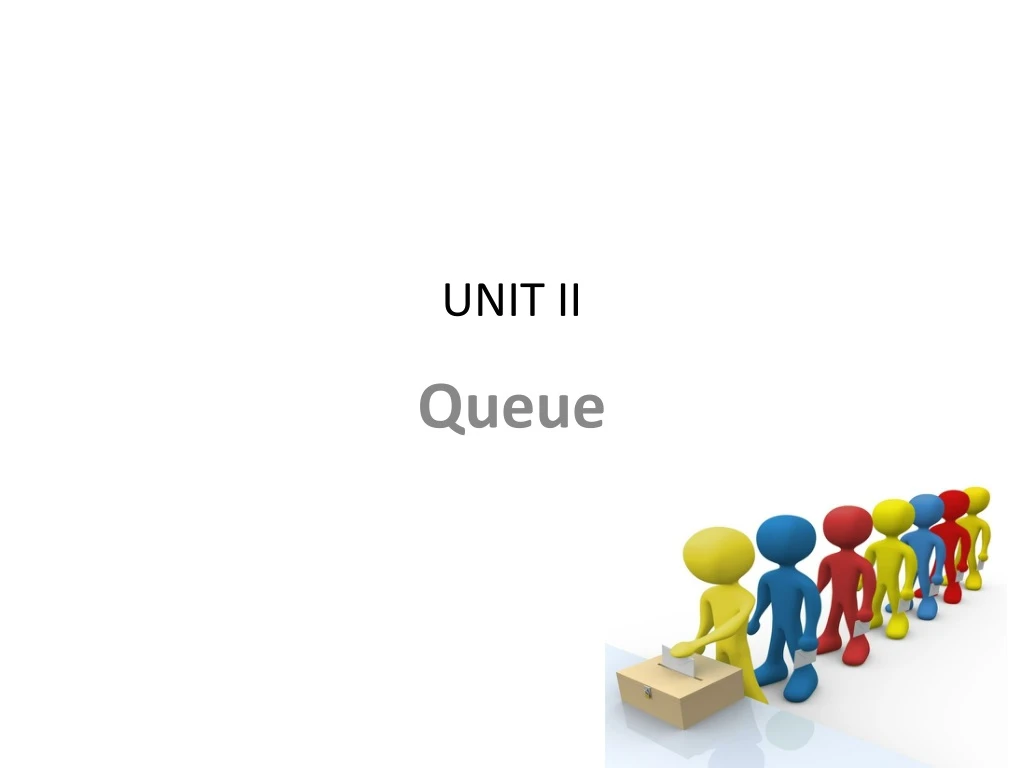
UNIT II Queue
Syllabus Contents • Concept of queue as ADT • Implementation using linked and sequential organization. • linear • circular queue • Concept • multiqueue • double ended queue • priority queue • Applications of queue
Abstract Data Type • What does ‘abstract’ mean? • From Latin: to ‘pull out’—the essentials • To defer or hide the details • Abstraction emphasizes essentials and defers the details, making engineering artifacts easier to use • I don’t need a mechanic’s understanding of what’s under a car’s hood in order to drive it • What’s the car’s interface? • What’s the implementation?
ADT = properties + operations • An ADT describes a set of objects sharing the same properties and behaviors • The properties of an ADT are its data (representing the internal state of each object • double d; -- bits representing exponent & mantissa are its data or state • The behaviors of an ADT are its operations or functions (operations on each instance) • sqrt(d) / 2; //operators & functions are its behaviors • Thus, an ADT couples its data and operations • OOP emphasizes data abstraction
Model for an abstract data type Inside the ADT are two different parts of the model: data structure and operations (public and private).
Definition of a Queue • A queue is a data structure that models/enforces the first-come first-serve order, or equivalently the first-in first-out (FIFO) order. • That is, the element that is inserted first into the queue will be the element that will deleted first, and the element that is inserted last is deleted last. • A waiting line is a good real-life example of a queue. (In fact, the British word for “line” is “queue”.) cinemark
A Graphic Model of a Queue front: All items are deleted from this end rear: All new items are added on this end
Operations on Queues • Insert(item): (also called enqueue) • It adds a new item to the rear of the queue • Remove( ): (also called delete or dequeue) • It deletes the front item of the queue, and returns to the caller. If the queue is already empty, this operation returns NULL • getfront( ): • Returns the value in the front element of the queue • getrear( ): • Returns the value in the rear element of the queue • isEmpty( ) • Returns true if the queue has no items • isFull() • Returns true if the queue is full • size( ) • Returns the number of items in the queue
Queue ADT objects: a finite ordered list with zero or more elements.methods: for all queue Queue, item element, max_ queue_ size positive integerQueue createQ(max_queue_size) ::= create an empty queue whose maximum size ismax_queue_sizeBoolean isFullQ(queue, max_queue_size) ::= if(number of elements in queue == max_queue_size) returnTRUEelse returnFALSE
Queue Enqueue(queue, item) ::= if (IsFullQ(queue)) queue_full else insert item at rear of queue and return queue Boolean isEmptyQ(queue) ::= if (queue ==CreateQ(max_queue_size))return TRUEelse returnFALSE Elementdequeue(queue) ::=if (IsEmptyQ(queue)) return else remove and return the item at front of queue. Queue ADT (cont’d)
Array-based Queue Implementation • As with the array-based stack implementation, the array is of fixed size • A queue of maximum N elements • Slightly more complicated • Need to maintain track of both front and rear Implementation 1 Implementation 2
FIFO queue ADT interface template <class Item> class QUEUE { private: // Implementation-dependent code public: QUEUE(int); int empty(); void put(Item); Item get(); int full(); };
Linear Queue Operation • Explain all operations with example
Linear queue array implementation template <class Item> class QUEUE { private: Item *q; int N, front, rear; public: QUEUE(intmaxN) { q = new Item[maxN+1]; N = maxN+1; front = 0; rear = 0; } int empty() const { return front % N == rear; } void put(Item item) { q[rear++] = item; rear = rear % N; } Item get() { front = front % N; return q[front++]; } int full() const { return rear == maxN; } }; If front = rear, then empty; if put would make them equal, then full. Array is 1 larger to allow checks.
Circular Queue Operations EMPTY QUEUE [2] [1] [2] [1] J2 J3 [0] [3] [0] [3] J1 [5] [4] [5] [4] front = 0 front = 0 rear = 0 rear = 2
FULL QUEUE FULL QUEUE [1] [2] [1] [2] J8 J9 J2 J3 J7 J10 [0] [3][0] [3] J1 J4 J6 J5 J6 J5 [5] [4] [5] [4] front =0 rear = 4 front =4 rear =2
Circular Queue Operations • Explain all operations with example
Circular queue array implementation template <class Item> class QUEUE { private: Item *q; int N, front, rear; public: QUEUE(intmaxN) { q = new Item[maxN]; N = maxN; front = maxN; rear = 0; } int empty() const { return front % N == rear; } void put(Item item) { q[rear++] = item; rear = rear % N; } Item get() { front = front % N; return q[front++]; } int full() const { return (rear+1)%N == front; } }; If front = rear, then empty; if put would make them equal, then full. Array is 1 larger to allow checks.
Linear Queue using Linked List • Explain all operations with example
Linear queue linked-list implementation template <class Item> class QUEUE { private: struct node { Item item; node* next; node(Item x) { item = x; next = 0; } }; typedef node *link; link head, tail; public: QUEUE(int) { head = 0; } int empty() const { return head == 0; } void put(Item x) { link t = tail; tail = new node(x); if (head == 0) head = tail; else t->next = tail; } Item get() { Item v = head->item; link t = head->next; delete head; head = t; return v; } };
Circular Queue using Linked List • Explain all operations with example
Circular queue linked-list implementation template <class Item> class QUEUE { private: struct node { Item item; node* next; node(Item x) { item = x; next = 0; } }; typedef node *link; link head, tail; public: QUEUE(int) { head = 0; } int empty() const { return head == 0; } void put(Item x) { link t = tail; tail = new node(x); if (head == 0) { head = tail; head->next=head;} else { t->next = tail; tail->next = head; } } Item get() { Item v = head->item; link t = head->next; delete head; head = t; tail->next = head; return v; } };
Algorithm Analysis • enqueueO(1) • dequeueO(1) • size O(1) • isEmptyO(1) • isFullO(1)
multiqueue • More than one queue in a single array or Linked list • eg. Patient Queue in a Hospital • Multiple Queue handle by multiple arrays • eg. Multiple priority Queue for processes
double ended queue • It is called as dequeue • (which is verb meaning to “remove element from Queue) • Make use both the ends for insertion & deletion of the elements • can use it as a Queue & Stack • Explain with Example
Priority queue • Elements associated with specific ordering • Two types • Ascending priority queue • Descending priority queue • Application • Priority scheduling in OS • N/W communication
Implementation of Priority Queue template <class Item> class QUEUE { private: struct node { Item item; int priority; node* next; node(Item x) { item = x; next = 0; } }; typedef node *link; link head; public: QUEUE(int) { head = 0; } int empty() const { return head == 0; } item get() { item patient = head->item ; head = head->next; return patient; }
Implementation of Priority Queue ( continue…) void put(Item x int p) { link temp , prev , nPatient = new node(x); nPatient->priority = p; if (head == 0) head = nPatient; else { temp = prev = head; while( temp->priority >= p & temp != 0) { prev = temp; temp = temp->next;} if( temp == head ) { nPatient->next = head ; head = nPatient; } else { prev->next = nPatient; nPatient->next = temp; } } };
Queues Applications • An electronic mailbox is a queue • The ordering is chronological (by arrival time) • A waiting line in a store, at a service counter, on a one-lane road, Patient in a Hospital • Applications related to Computer Science • Threads • Job scheduling (e.g. Round-Robin algorithm for CPU allocation)