Download
1 / 6
60 likes | 165 Vues
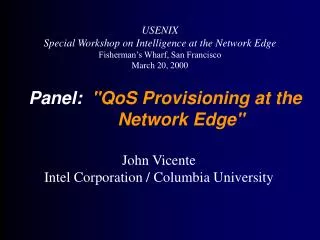
This text outlines the key discussions from the panel titled "QoS Provisioning at the Network Edge," held at the USENIX Special Workshop on Intelligence at the Network Edge in March 2000. Panelists, including experts from Intel Corporation and Columbia University, explored the levels of intelligence necessary for effective Quality of Service (QoS) at the network edge, considering timing, consumer needs, industry evolution, and network programmability. The conversation also addressed whether IP-based QoS has been fully resolved and the role of network programmability in enhancing QoS through dynamic and automated solutions.

E N D
USENIX Special Workshop on Intelligence at the Network EdgeFisherman’s Wharf, San Francisco March 20, 2000 Panel: "QoS Provisioning at the Network Edge" John Vicente Intel Corporation / Columbia University
“What level of intelligence at the edge will be sufficient to achieve QoS?” • Timing considerations • Consumer driven • Industry evolution • Network architectural considerations • Level of programmability • Degree of abstraction • Panel Q: Have we resolved IP-based QoS? • Is network programmability a solution for IP QoS?
Ubiquitous IP Infrastructure • Convergence, integration and efficiency • Multi-service aggregation devices • QoS, security, provisioning and network management • ToS, 802.1p, DiffServ, MPLS, RSVP, bandwidth broker(?) – or a hybrid • Policy-based management & COPS • Configured (management scale) policies to provision, service differentiate and perform bandwidth segmentation • Packet content-based metering & provisioning
Open Network Architectures • Open and horizontal …enabling interoperability, open markets, flexibility • Increasing network intelligence • Standard APIs & programmable building blocks • Flexible, dynamic QoS control and provisioning
Programmable Internet Platform • Network automation and customization ….enabling privacy, personalization and autonomy (i.e., programmability and QoS) • Network shares computation with the end systems • Advanced middleware & programmability models • Unified APIs and common network abstractions • Automate the networking design, deployment process • Ultimate network abstraction =>Programmable virtual networks • Transforming the “edge”
Updates OPENSIG’2000 will be hosted by Intel in October of this year. The Intel IX Architecture is a new approach to designing networking and telecommunications equipment based on reprogrammable silicon and open interfaces. …more information on how to join the Intel Internet Exchange Architecture Developers Forum, visit http://www.ixarchitectureforum.org.