Discovering Venus: Earth's Twin in Size, Mass, and Unique Rotation
50 likes | 161 Vues
Venus, often referred to as Earth's Twin, has a radius of 6,051 km (94.9% of Earth's) and a mass of approximately 0.815 Earth masses, or 4.87 x 10^24 kg. Its density is similar to Earth's at 5.25 g/cm³ and exhibits surface gravity of 8.87 m/s². Orbiting at a distance of 723 AU (108.2 million km), Venus has an orbital period of 224.7 Earth days, while its unique rotation takes 243 Earth days, spinning retrograde. This unusual tilt and slow spin result in a weak magnetic field, unprotected from solar winds. The planet’s name is derived from the Roman goddess of beauty.


Discovering Venus: Earth's Twin in Size, Mass, and Unique Rotation
E N D
Presentation Transcript
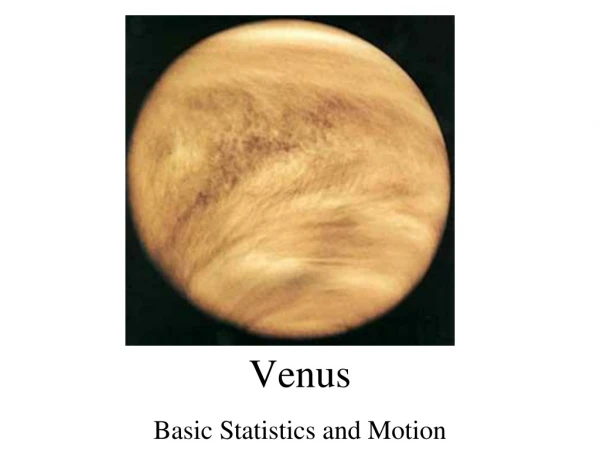
Venus Basic Statistics and Motion
Size and Mass Radius: 6,051 km (94.9% of Earth’s) It’s just a little smaller than Earth. Mass: .815 of Earth Masses (4.87 x 10^24 kg) It’s just a little less massive Density: 5.25 g/cm³ ( 95.1% of Earth’s) About the same Surface Gravity: 8.87 m/s² (90.5% of Earth’s) About the same That’s why it is known as Earth’s Twin. Name Origin Roman Goddess of Beauty
Orbit Radius: .723 AU ( 108.2 million km) Period (year): 224.7 Earth days Rotation Sidereal Day (Period): 243 Earth days Solar Day: 117 Earth days Direction: Retrograde Venus is tilted almost upside down (177°) Thus it spins backward compared to other planets! Therefore the revolution and rotation work together to make the solar day shorter than the Sidereal day
A Weak Magnetic Field The Venusian magnetic field is weak compared to Earth because It spins so slowly (Thus Venus is not protected from the Solar Wind/Flares)
Why the weird spin? Two Hypotheses: • Tilt: Venus collided with a very large planetismal that Flipped it over (and may have slowed it down). • Speed: Tidal forces from the Sun and Earth influenced its spin