
SlideServe
Menu
Préférences
© SlideServe · v2026

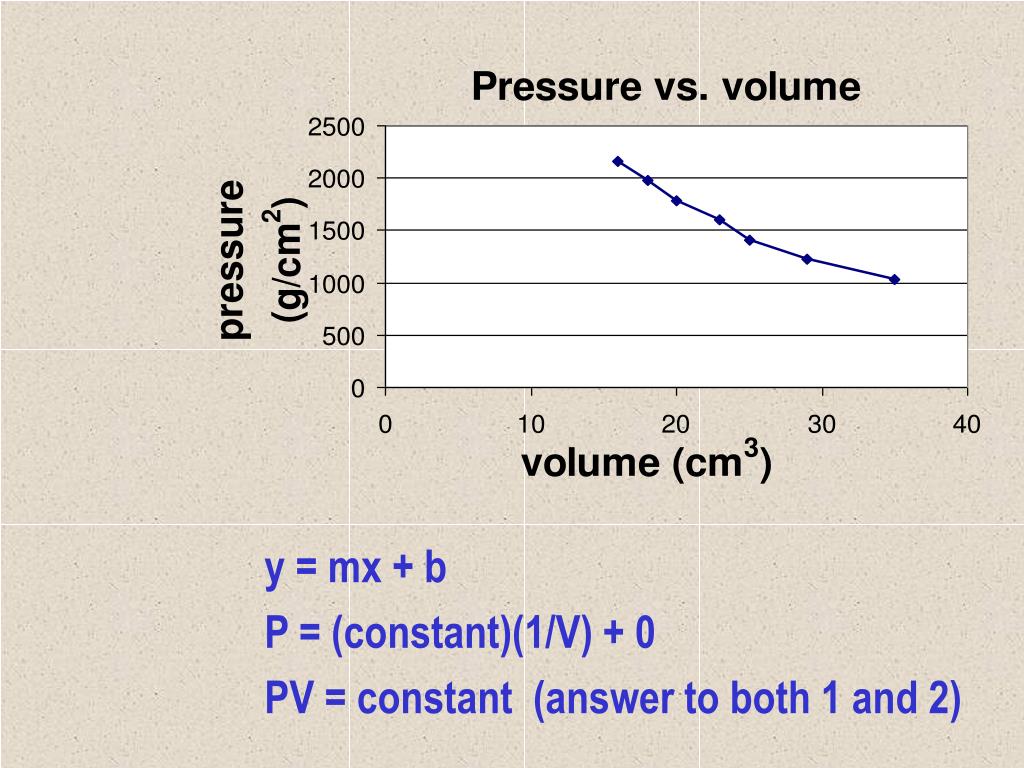
y = mx + b P = (constant)(1/V) + 0 PV = constant (answer to both 1 and 2)

candice-chaney avatar
7 diapositives · 361 Views · Nov 01, 2014

y = mx + b P = (constant)(1/V) + 0 PV = constant (answer to both 1 and 2). Conclusions and Questions. 1. If P doubles, V is cut in half. If P is tripled, V becomes 1/3 of its original value.
y = mx + b P = (constant)(1/V) + 0 PV = constant (answer to both 1 and 2) - slide 1
01 / 7y = mx + b P = (constant)(1/V) + 0 PV = constant (answer to both 1 and 2)
1 / 17

Télécharger la présentation

y = mx + b P = (constant)(1/V) + 0 PV = constant (answer to both 1 and 2)
Une image / un lien ci-dessous est fourni (tel quel) pour télécharger la présentation

Politique de téléchargement : le contenu du site vous est fourni TEL QUEL pour votre information et votre usage personnel ; il ne peut être vendu, concédé sous licence ni partagé sur d’autres sites sans l’accord de son auteur.Le contenu vous est fourni TEL QUEL, pour votre information et votre usage personnel uniquement. Téléchargez la présentation en cliquant sur ce lien. Lors du téléchargement, si vous ne parvenez pas à télécharger une présentation, l’éditeur a peut-être supprimé le fichier de son serveur.Pendant le téléchargement, si vous ne parvenez pas à obtenir une présentation, le fichier a peut-être été supprimé par l’éditeur.

F I N

Plus de contenu associé

Transcription de la présentation
  1. y = mx + b P = (constant)(1/V) + 0 PV = constant (answer to both 1 and 2)

  2. Conclusions and Questions 1. If P doubles, V is cut in half. If P is tripled, V becomes 1/3 of its original value. 2. “As the pressure on a gas increases, the volume of the gas decreases proportionally, provided that the temperature and amount of gas remain constant”. I.e. P1V1 = P2V2.

  3. 3. As volume decreases, there are more collisions with the side of the container per unit of time, thus the pressure increases. 4. Boyle’s states that pressure is inversely related to volume, if the temperature and # of particles (in moles, n) are constant

  4. By comparing values in the PV column and via the graph we see that PV = constant • Boyle’s law: P1V1 = P2V2

  5. Sample Questions 1. At 103 kPa, a gas has a volume of 5.2 L. What is its volume if the pressure is increased to 400 kPa? 2. A gas at 700 mm Hg has a volume of 200 mL. ? atm of pressure will make the volume 950 mL.

  6. Answers: 1. P1=103kPa, V1=5.2L, P2=400kPa, V2=? Using Boyle’s law: P1V1 = P2V2, 103 kPa x 5.2 L = 400 kPa x V2 V2= (103 kPa x 5.2 L) / 400 kPa = 1.34 L

  7. 2. P1= 700 mm Hg x 1 atm / 760 mm Hg = 0.921 atm, V1= 200 ml, P2= ?, V2= 950 ml Using Boyle’s law: P1V1 = P2V2 0.921 atm x 200 ml = P2 x 950 ml P2= (0.921 atm x 200 ml)/950ml=0.194 atm