
Populations
E N D
Presentation Transcript
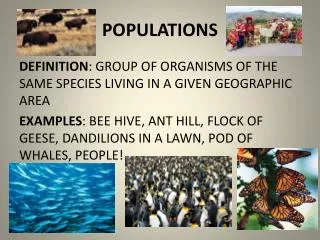
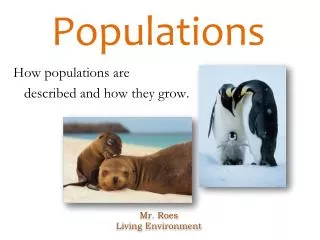
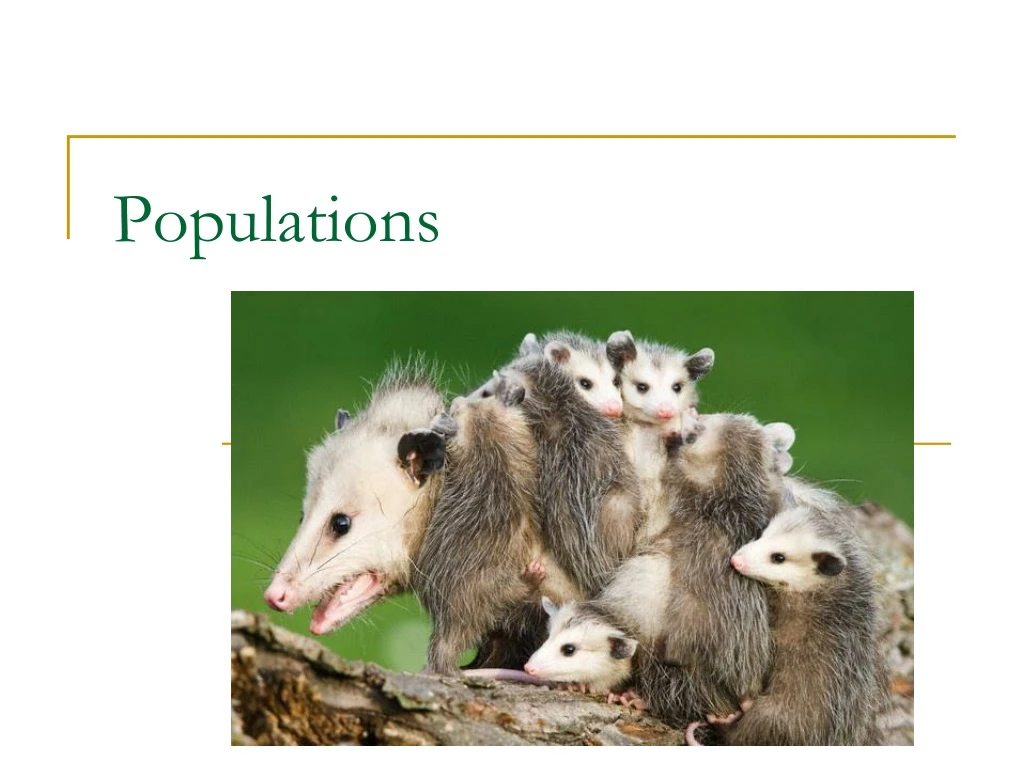
Populations • A population is all the individuals of a species that live in the same area.
Characteristics of Populations • Four characteristics: • Geographic distribution • Density • Growth rate • Age structure
Geographic Distribution • The area inhabited by a population. • The range can vary in size from a few cubic centimeters to millions of square kilometers.
Population Density • The number of individuals per unit area. • The number can vary depending on species and ecosystem. • Ex. Saguaro cactus in the desert plant community has a low density. Sage brush has a high density.
Population Dispersion • Population dispersion is the way in which individuals of a population are spread in an area or volume. • Clumped dispersion • Individuals may live close together in groups in order to facilitate mating, gain protection, or access food resources. • Uniform dispersion • Territoriality and intraspecies competition for limited resources lead to individuals living at specific distances from one another. • Random dispersion • Individuals are spread randomly within an area or a volume.
Survivorship Curves • A survivorship curve is a generalized diagram showing the number of surviving members over time from a measured set of births. • By measuring the number of offspring born in a year and following those offspring through until death, survivorship curves give information about the life history of a species. • There are three basic patterns of animal survivorship curves.
Survivorship Curve • Type I • This represents a life history that is common among large mammals. • It shows a low infant mortality and a population that will generally survive until old age. • A behavior shared by organisms showing Type I survivorship curves is parental care for the young.
Survivorship Curve • Type II • Organisms such as birds, small mammals, and some reptiles show a survivorship rate that is roughly equal at all ages of an organism’s life. • At all times, these species have an equal chance of living and dying, whether as a result of predation or from disease.
Survivorship Curve • Type III • These organisms have a very high birth rate and also a very high infant mortality rate. • These species are generally invertebrates, fish, amphibians, and plants. • Many of their offspring will die from predation, but inevitably, a few will survive to adulthood and pass on their genes to the next generation.
Population Growth • Natural populations stay the same size from year to year. • Three factors affect population size: • Number of births • Number of deaths • Number of individuals that enter or leave the population.
Population Growth • A population can grow when its birthrate is greater than its death rate.
Population Growth • If the birthrate equals the death rate, the population stays the same size.
Population Growth • If the death rate is greater than the birthrate, the population shrinks.
Population Growth • Immigration • The movement of individuals into an area. • Causes population growth. • Emigration • The movement of individuals out of an area. • Causes population decline.
Exponential Growth • If a population has abundant space and food, and is protected from predators and disease, then organisms in that population will multiply and the population size will increase.
Exponential Growth • Exponential Growth • Occurs when the individuals in a population reproduce at a constant rate. • It will grow slowly at first, then faster and faster. • Under ideal conditions with unlimited resources, a population will grow exponentially.
Exponential Growth • The current population of African elephants is 470,000 to 690,000 individuals (down from 1.3 million) • An elephant can produce offspring only every 2 to 4 years (they’re pregnant for 22 months!) • The baby’s take 10 years to mature and cannot reproduce until ~13 years of age. • If all the offspring of a single pair of elephants survived and reproduced for 750 years there would be nearly 20 million elephants!
Logistic Growth • As resources become less available, the growth of a population slows or stops. • Logistic growth • Occurs when a population’s growth stops or slows down after a period of exponential growth.
Logistic Growth • Will occur when: • Death increases • Emigration increases • Birthrate decreases • Immigration decreases
Logistic Growth • Carrying Capacity (K) • The environment can only support so many individuals. • The number that represents the largest amount of individuals an environment can support at any one time is the carrying capacity.
Age Structure • Age structure is the summary of individuals at each age in the population. • Age structure is useful in understanding and predicting population growth.
Age Structure • If you know the age of reproduction and the reproductive strategy of a population, you can predict when or if it will grow.
Limiting Factors • Limiting Factor • Any factor that causes population growth to decrease • Competition • Predation • Parasitism and disease • Drought and other climate extremes • Human disturbances
Density-Dependent Factors • Density-Dependent Factor • A limiting factor that depends on population size. • Factors become limiting only when a population has reached a certain size. • Factors operate most strongly when a population is large and dense. • They do not affect small, scattered populations as greatly. • Competition, predation, parasitism, and disease are all density-dependent factors.
Density-Dependent Factors • Competition • When populations become crowded, organisms compete with each other for food, water, space, sunlight, and other essentials. • Can occur between members of the same species • Can occur between members of different species • Is a major source of evolutionary change
Density-Dependent Factors • Predation • Predator-prey relationships are the best known mechanisms of population control. • Ex. Wolves and Moose on Lake Superior • When the moose population increases, the wolf population increases shortly afterward. • As the wolf population increases, the moose population decreases (due to predation), followed shortly by a decrease in wolf population.
Density-Dependent Factors • Parasitism • Parasitic organisms can range in size from microscopic to 30 centimeters or more in length (tapeworm) • Parasites are similar to predators • They take nourishment at the expense of their hosts, weakening them and causing disease or death as a result.
Density-Dependent Factors • Disease • The closer packed a population is, the faster disease will spread. • The Black Plague killed about 75 million people in 1340.
Density-Independent Factors • Density-Independent Factors • Affect all populations in similar ways, regardless of the population size. • Unusual weather, natural disasters, seasonal cycles, certain human activities (damming rivers, clear-cutting forests).
Density-Independent Factors • Regardless if the population has 5,000,000 individuals or 5,000, a hurricane, fire, or drought can kill them all off.