Minerals
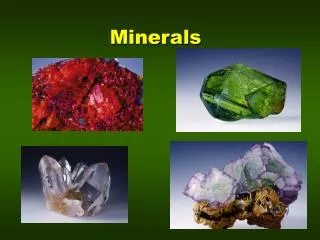
Minerals are naturally occurring inorganic solids with a definite chemical composition. They can form through processes like crystallization from magma, precipitation, and hydrothermal solutions. Minerals are classified into groups such as silicates, carbonates, and oxides based on their composition. Identification of minerals involves observing key properties such as color, luster, crystal shape, streak, cleavage, fracture, and hardness using standardized scales. Understanding these characteristics allows for accurate identification of over 2,000 known minerals.

Minerals
E N D
Presentation Transcript
Minerals Chapter 2
Mineral: a naturally occurring substance formed in the Earth • Inorganic • Solid substance • Definite chemical composition
How Minerals Form 1. Crystallization from magma 2. Precipitation 3.Pressure and temperature 4. Hydrothermal solutions
Mineral Groups • Can be classified based on their composition 1. Silicates • Silicon and oxygen combine to form a structure called the silicon-oxygen tetrahedron. 2. Carbonates • Minerals that contain the elements carbon, oxygen, and one or more other metallic elements 3. Oxides • Minerals that contain oxygen and one or more other elements, which are usually metals
Mineral Groups 4. Sulfates and Sulfides • Minerals that contain the element sulfur 5. Halides • Minerals that contain a halogen ion plus one or more other elements 6. Native elements • Minerals that exist in relatively pure form
Identifying Minerals: 1. Color • Most easily observed property • Yet, least useful property
Identifying Minerals:ColorWhy it is the least useful property… • Different minerals have the same color • One mineral can have different colors • Impurities can alter color • Some change color when exposed to air • Light can distort color
Identifying Minerals: 2. Luster • Way a mineral shines
Identifying Minerals: Luster Metallic: shines like polished metal Pyrite “Fool’s Gold”
Identifying Minerals: Luster Nonmetallic: does not shine like metal
Identifying Minerals: Luster Pearly like a pearl Talc
Identifying Minerals: Luster Greasy Turquoise
Identifying Minerals: Luster Vitreous like shining glass Amethyst
Identifying Minerals: Luster Resinous like wax
Identifying Minerals: Luster Dull or Earthy Bauxite
Identifying Minerals: 3. Crystal Shape • The shape of a crystal results from the way the atoms of a mineral come together as the mineral forms
Identifying Minerals: 4. Streak Test • Color of a mineral’s powder form • Usually, streak is not the same color as the mineral • Streak doesn’t vary
Identifying Minerals: Streak Test • Metallic mineral has dark streak • Nonmetallic – colorless or light streak
Identifying Minerals: 5. Cleavage • The splitting of a mineral along certain flat surfaces • Related to the types of bonds in the internal structure of the mineral
Identifying Minerals: 6. Fracture • the way a mineral tends to break –unevenly!!!
Identifying Minerals: Fracture Splintery jagged
Identifying Minerals: 7. Hardness • Resistance to being scratched • Moh’s hardness scale
Mohs Scale, identified numerically by standard minerals, from 1 (softest) to 10 (hardest): 1. Talc 2. Gypsum 3. Calcite 4. Fluorite 5. Apatite 6. Orthoclase 7. Quartz 8. Topaz 9. Corundum 10. Diamond
To remember the Mohs scale try remembering this phrase: The Geologist Can Find An Ordinary Quartz, (that) TouristsCall Diamond!
Tools for Testing Hardness • You typically do not carry around a supply of the 10 minerals on the hardness scale. However, you can use the following items to help estimate the hardness of a mineral:
Tools for Testing Hardness • finger nail (H = 2.5) • penny (H = 3.5) • common nail (H = 4.5) • glass plate (H = 5.5)
Identifying Minerals: Special Properties • Acid test http://www.westhamptonbeach.k12.ny.us/Teachers/Cohen/sciweb/earthscience/sedimentary/Mvc-327w.mpg
Identifying Minerals: Special Properties • Magnetic test
Identifying Minerals: Special Properties • Taste test Some minerals have a distinct taste. Never do this test after the acid test!
Common Rock-forming Minerals Quartz
Feldspar Mica
Talc Amphiboles
Galena Halite
Biotite Calcite
Hematite Pyrite
Magnitie Olivine