Quantum Dot Bioconjugates for Imaging, Labelling and Sensing
110 likes | 237 Vues
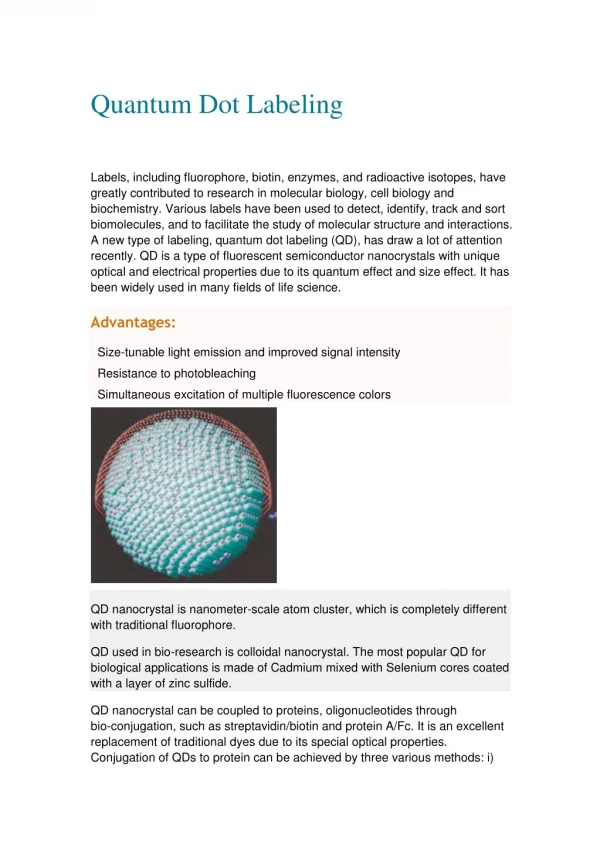
This presentation discusses the transformative role of Quantum Dots (QDs) in the fields of imaging, labeling, and sensing. Highlighted are the applications and benefits of QDs, including their unique properties such as high quantum yield and resistance to photobleaching, making them superior to organic fluorophores. Current capabilities in QD manufacturing for biological applications are explored, along with techniques for connecting QDs to biomolecules. The presentation also addresses challenges such as toxicity and the need for further research into their long-term effects and applicability in vivo.


Quantum Dot Bioconjugates for Imaging, Labelling and Sensing
E N D
Presentation Transcript
Quantum Dot Bioconjugates for Imaging, Labelling and Sensing By: Igor L. Medintz, H. Tetsuo Uyeda, Ellen R. Goldman, and Hedi Mattoussi Nature Materials, June 2005 Presented by: Marshal Miller
Outline • Applications • Benefits of QDs • Current Capabilities • Manufacturing process • Connection to bio-molecules • Future directions
Bio-Applications • in vivo and in vitro flourophores • Cellular labelling (cancer cells) • Deep-tissue imaging • Efficient fluorescence resonance energy transfer (FRET) donors • Understand interplay of biomolecules
QD vs Organic Labelling • Organic and genetic fluorophores • Low photobleaching threshold • Broad absorption and emission profiles • QDs properties • High resistance to photobleaching and photo and chemical degradation • Broad absorption, but narrow emission (FWHM ~25-40nm) • High quantum yield • High molar extinction coefficients (~10-100x organic) • Wide range (UV – IR) • Large Stokes shifts CdSe core: 13.5-24.0 Ǻ
QD Properties Alexa 488 QD 630
Current Capabilities • Best QDs for bio-applications (June 2005) are CdSe cores with ZnS layer • Easily reproducible/Refined chemistry • Wide range of emission • ZnS: • Passivates the core surface • Protects core from oxidation • Prevents Cd/Se from leeching into surrounding solution • Produces higher photoluminescence yield • Other colloidal nanocrystals: ZnS, CdS, ZnSe, CdTe, PbSe • Problems with reproducibility • Inorganic passivation
Methods for preparing QD bioconjugates • Production of CdSe • TOPO dried by heating to 200 oC at 1 Torr for 20 min • Reaction flask stabilized at 300 oC at 1atm of argon • A:1.00 mL of Me2Cd added to 25.0 mL of TOP in drybox • B: 10.0 mL of TOPSe added to 15.0mL of TOP • A added to B • Removed from heat put in vigorously stirring reaction flask • Temp falls to 180 oC, then heated to restore the temp to 230-260 oC • Absorption spectra taken every 5-10 mins to monitor growth • Raising the temp increases growth rate • Once desired size is observed, portion of growth solution transferred to a vial • Can isolate a series of sizes (15 to 115 Ǻ) from one batch TOP = trioctyl phosphine, TOPO = trioctyl phosphine oxide, Me2Cd = Dimethylcadmium Process from: Synthesis and Characterization of Nearly Monodisperse CdE Semiconductor Nanocrystals, Murray et. al. J. Am. Chem. Soc. 1993
Connecting to Biomolecules • Uses ‘cap exchange’ by substituting TOP/TOPO with bifunctional ligands (ex thiol) • Formation of polymerized silica shells functionalized with polar groups • Preserves TOP/TOPO and uses amphiphilic ‘diblock’ and ‘triblock’ copolymers and phospholipids
Problems/Future Directions • Toxicity of inorganic Cd, Se, Zn, Te, Hg, Pb • Toxins, neurotoxins, teratogens • Reports of QDs damaging DNA • Have been some long-term in vivo studies showing no evidence of toxicity • No long term animal studies • How are particles cleared metabolically? • Do QDs mirror true in vivo behavior? • Multiplexing (6-10 signals at varying intensities) bar codes for synthetic products • Flexible bioconjugation • Make processes more reproducible
The End Thank you for your attention Questions?