Exploring Ancient Greek Civilization: Geography, Achievements, Religion, and Trade
This review addresses key aspects of ancient Greek civilization, exploring how Greece's geography shaped the development of city-states by isolating early tribes. It highlights the Minoans' notable achievements and reasons for their empire's collapse, as well as the Mycenaeans' contributions. The concept of the Polis and its defining ideas are discussed, alongside Greek religious beliefs and the significance of Olympian gods like Zeus. Additionally, it examines agricultural practices, trade dynamics, and the vital exchanges between city-states, rooted in geographical advantages.

Exploring Ancient Greek Civilization: Geography, Achievements, Religion, and Trade
E N D
Presentation Transcript
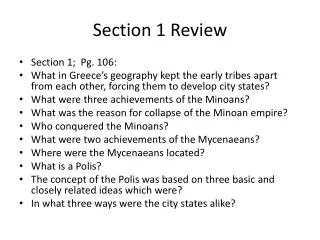
Section 1 Review • Section 1; Pg. 106: • What in Greece’s geography kept the early tribes apart from each other, forcing them to develop city states? • What were three achievements of the Minoans? • What was the reason for collapse of the Minoan empire? • Who conquered the Minoans? • What were two achievements of the Mycenaeans? • Where were the Mycenaeans located? • What is a Polis? • The concept of the Polis was based on three basic and closely related ideas which were? • In what three ways were the city states alike?
Section 2 Review • Section 2; pg. 110: • What three things did the Greeks look for in religion? • What is a Myth? • Who was Zeus? • What is an oracle? • In whose honor were the Olympics held in? • How often were the Olympics held? • Explain what an aristocracy is. • Explain what a democracy is.
Agriculture and livestock in Greece • Agriculture • Olive Tree • Grapevines • Herbs • Vegetables • Because of Greece’s geography, some crops could not grow. • Livestock • Sheep • Goats • Bee’s for honey
Trade • Exchange of goods between one civilization and another. • Based on the resources a civilization had or did not have • Civilizations would trade with other civilizations for materials or resources that their civilization was lacking in.
Trade in the Country of Greece • Greece is a country surrounded by water and therefore, trade was very important • Greece’s main exports were: Pottery, Bronze, Silver, Gold Vessels, Olive Oil, Wine, and Textiles
Trade within City States • Cyprus/ Crete: Ivory carving, jewelry making, gem cutting, metalworking • Corinth: Corinthian vases filled with olive oil in return for grain • Aegean Islands and Mainland Greece: Marble • Sicily: Limestone • Athens: Pottery