Download
1 / 25
250 likes | 354 Vues
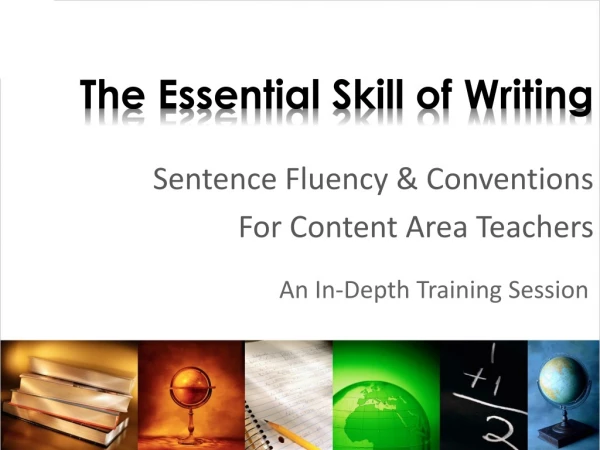
Join us for an in-depth training session designed to empower educators in understanding the key components of writing, particularly focusing on Ideas, Content, and Organization. Participants will learn to recognize student performance at various score levels, develop expertise in scoring writing for classroom and Essential Skills purposes, and align their assessments with Common Core State Standards. This workshop will also address scoring issues, rater bias, and provide resources for effective assessment in content area classes.

E N D
The Essential Skill of Writing Ideas/Content and Organization For Content Area Teachers An In-Depth Training Session
Goals for this Workshop Participants will • Understand the key components of the traits of Ideas/Content and Organization • Recognize student performance at different score levels for Ideas/Content and Organization
Goals, continued • Develop expertise in scoring student writing for classroom and Essential Skills purposes in Ideas/Content and Organization • Understand how CCSS for Writing in History/Social Studies, Science and Technical Subjects align with Oregon’s writing assessment model
Scoring Issues • Four modes – Expository, Persuasive, Narrative, Imaginative • Rater bias • Response to topic • Purpose of assessment
Oregon aligns with Common Core State Standards Oregon Modes of Writing CCSS Text Types & Purposes Arguments asserting and defending claims Informative/Explanatory Narratives – real or imagined • Persuasive • Expository • Narrative • Imaginative
Writing in Content Classes Student writing for content classes is more likely to be expository or persuasive.
Rater Bias What influences student scores?
Sources of Rater Bias • Appearance of paper (neat, legible, etc.) • Conflict with personal opinions, beliefs, values • Religious or political themes • Profanity or extreme violence • Sympathy score (student really tries hard) • Pet Peeve
Response to topic Purpose of Assessment
Classroom Assessment vs. Essential Skills Response to Topic • Important for Classroom Assignments • Does not affect Ideas and Content for Essential Skills Work Samples
Classroom Assessment vs. Essential Skills Purpose of Assessment • Consider purpose when deciding which traits to score – Classroom assignment? Formative assessment? Summative assessment? Essential Skills Work Sample?
Ideas and Content • Clear? • Focused? • ENOUGH developmental details? • Details relevant to main ideas?
Let’s Review the Scoring Guide Highlight words and phrases that help distinguish a score of 3 from a 4 in Ideas and Content
Organization • Can you follow the writing? • Introduction: developed? • Conclusion: developed? • Transitions: present? kinds of? (between and within paragraphs) • Paragraph breaks?
Let’s Review the Scoring Guide Highlight words and phrases that help distinguish a score of 3 from a 4 in Organization
Common Core State Standards • Adopted by Oregon State Board of Education • Require Literacy Instruction in History/Social Studies, Science and Technical Subjects
Comparing Oregon & CCSS • Where do you find words and phrases that echo concepts in Ideas and Content? • Where do you find words and phrases that echo concepts in Organization? • What modifications and adjustments do you foresee for writing in content classes?
Resources to Practice Scoring • ODE High School Writing Samples: http://www.ode.state.or.us/search/page/?=527 • OPEN Scoring Site: http://www.openc.k12.or.us/scoring/ • Clackamas ESD Writing Samples http://www.clackesd.k12.or.us/cie/writing.html