Essential Skill Paragraph
This analysis explores the extent to which Milton Meltzer's article "Kristallnacht" supports or refutes Elie Wiesel's assertion that "Silence encourages the tormentor, never the tormented." Through a close examination of key phrases, meanings, and evidence within Meltzer's text, we can uncover how language and diction reflect the complexities of silence during pivotal moments of historical atrocity. By evaluating the relationship between Meltzer's and Wiesel's ideas, the paper seeks to provide a nuanced understanding of how silence affects both oppressors and victims in contexts of violence and persecution.

Essential Skill Paragraph
E N D
Presentation Transcript
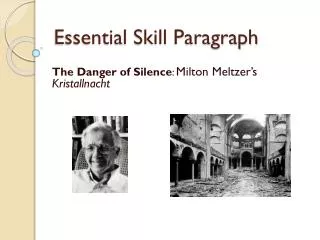
Essential Skill Paragraph The Danger of Silence: Milton Meltzer’s Kristallnacht
Prompt: To what extent does Milton Meltzer’s Kristallnacht support or refute Elie Wiesel’s idea that “Silence encourages the tormentor, never the tormented”?
Let’s prepare for formative #2 • Take out notes on author’s idea: • What are the key words? • What are the literal meanings of these words? • What are the figurative meanings of these words? • Choose appropriate evidence from text • Does each passage have loaded language for you to discuss? • Can you clearly explain which words from your evidence connect to the key words from the author idea?
Prompt: To what extent does Milton Metzer’sKristallnacht support or refute Elie Wiesel’s idea that “Silence encourages the tormentor, never the tormented”? • Topic Sentence: Milton Meltzer’s article titled “Kristallnacht” clearly supports Elie Wiesel’s idea… • C + Evidence #1: Embed “Evidence from article” (Meltzer). • Analysis 1: What is going on in the evidence? What is the literal meaning? • Analysis 2: Break down diction from both evidence and author idea. Discuss relevant figurative meanings. • Analysis 3: Highest level thinking; How does diction from evidence connect to key words from the author's idea? • Transition +C + Evidence #2: Meltzer further embodies Wiesel’s idea when… embed “CD from article” (Meltzer). • Analysis 1: What is going on in the evidence? What is the literal meaning? • Analysis 2: Break down diction from both evidence and author idea. Discuss relevant figurative meanings. • Analysis 3: Highest level thinking; How does diction from evidence connect to key words from the author's idea? • Concluding sentence: Restate TS powerfully!!!