Condition Audits for Grounds Assets
340 likes | 566 Vues
Condition Audits for Grounds Assets. TEFMA Grounds Workshop Brisbane, May 2007 Steve Lake, Business Improvement Manager Richard Phillips, Asset Protection Officer. Condition Audits for Grounds Assets.


Condition Audits for Grounds Assets
E N D
Presentation Transcript
Condition Audits forGrounds Assets TEFMA Grounds Workshop Brisbane, May 2007 Steve Lake, Business Improvement Manager Richard Phillips, Asset Protection Officer
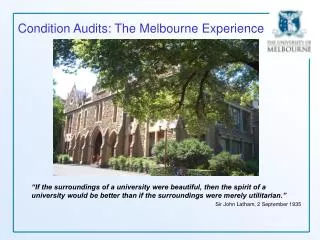
Condition Audits for Grounds Assets • “If the surroundings of a university were beautiful, then the spirit of a university would be better than if the surroundings were merely utilitarian.” • Sir John Latham, 2 September 1935
External Drivers • NCRB, 1995 • Acknowledged underspend on building maintenance across the tertiary education sector: • Desirable level of maintenance: 1-1.5% ARV • Average University spend: 0.8% ARV • Actual spend at UoM in 2005: 0.8% ARV • Group of 8, 2005 • TEFMA Benchmark Comparisons • Based on 5 year average (2000 – 2004)
Internal Drivers • AUQA Audit Report 2005: • “…recommends that UoM develop a plan for addressing the deferred maintenance problems ……...” • The Corporate Strategy: • “…maintain the condition of the University’s property portfolio in line with the Melbourne Experience.” • “…progressively renew physical infrastructure to support learning.” • “…an important aspect of the Melbourne Experience is the provision of a safe, attractive campus with outstanding educational, social, cultural and recreational amenities.” • Operational Review 2005: • “…a long term plan to reduce the maintenance backlog…”
Backlog Maintenance Strategy • Definition: • “Maintenance that is necessary to prevent the deterioration of the asset or its function but which has not been carried out.” (TEFMA) • Extent: • In 2005, the extent of the backlog was estimated at $203M. • Exclusions: • faculty equipment and room soft furnishings; • buildings less than 5 years of age; • buildings due to be demolished in the next 10 years; • normal items of routine maintenance; and • service upgrades.
The TEFMA Model • AAPPA Guidelines for Strategic Asset Management (2000) • Uniformat II Classification for Building Elements • Rating Tables for: • Condition • Risk • Importance • Functionality • Facility Condition Index and Overall Rating System • No classification system for Grounds
Project Plan • Stage 1: March – May 2006 • Researched the TEFMA Community and Commercial models • Undertook a Pilot Study • Stage 2: May – March 2007 • Train Internal Assessment Team • Undertake Assessment of Parkville Campus • Stage 3: January – December 2007 • Produce a prioritised Backlog Maintenance Program • Conduct Stakeholder Consultation • Develop Long Term Program
Data Management • Audit spreadsheets (Microsoft Excel) offer advantages when considering individual buildings / grounds zones but have limitations for campus wide data analysis. • Considered BEIMS, Archibus and other proprietary tools. • Selected BEIMS as the preferred tool because: • SQL Server database offers required functionality for data storage, analysis and reporting in the long term; • we already use BEIMS for work order management; • Mercury Computer Systems were prepared to work with us in developing a TEFMA-based Condition Audit module and data upload tools for our Audit spreadsheets; and • control, custodianship, flexibility and value for money.
Early Wins! • $61M Funding approved in May 2006: • commencing 2007 • rising from $5M to $20M in 2011 • Support from Mercury Computer Systems to develop BEIMS Condition Audit module • We could now focus on conducting a full audit of the Parkville campus
Prioritisation Model Total Estimated Backlog ($200+ Million) Condition and Appearance Risk and Importance Functionality Program of Works for 2007 – 2011 ($61 million)
Consultation • Developed a 20 question Facility Condition Survey form. • Questions have been aligned to individual building and grounds elements to facilitate comparison. • ~50 key stakeholders identified across all faculties to coordinate surveys within their own buildings. • Currently establishing correlation between responses and condition audit. • Developed 2 page Summary Plans for each Building / Grounds Zone to facilitate effective communication with individual faculties.
Functionality Rating Practical Assessment of strategic initiatives Determination of Timing and Funding • Consideration given to planned refurbishments, demolitions, etc. – reality check so that the outcome has maximum effect. • Consideration given to changes in regulations and other strategic initiatives (i.e. energy and water conservation). • Consideration of appropriate source of funding (i.e. Backlog Maintenance, Compliance, Discretionary, etc.)
2007 Works Program Grounds
Analysis and Reporting • Using analysis and reporting functions within new BEIMS ‘Building Condition Assessment’ (BCA) module. • Reports available (for Buildings): • by element and priority / condition within a specific building • by element and priority / condition across all buildings • by overall building condition or appearance • and by various combinations and selections • A ‘Grounds Condition Assessment’ module has not been developed as yet.
Achievements Thus Far • Established Assessment Team (internal staff + external contractors) • Engaged Consultants for Specialist Assessment • Assessed ~70 Buildings and 10 Grounds Zones • Captured Routine Maintenance works • Developed Progress Reporting Tools • Developed new BEIMS ‘Building Condition Assessment’ module • Developed a Consultation Framework • Committed $2 million to date of 2007 Works Program
Grounds: In the Beginning…. My Role: Grounds Planning Officer with non-audit responsibilities. Issue: No existing audit classifications with a GROUNDS / LANDSCAPE Focus. • Challenges: • Modification of the building classification system to suit our Grounds assets. • Undertaking Grounds Audits • Existing commitments and responsibilities
What are the Major Element Groups? • Services • Surfaces • Horticulture • Fixtures & Structures • Sports Precincts
Element Groups • A. Services • A10Below Ground Services • A1010 Water Reticulation • A1020 Stormwater / Drainage • Etc.. • A20Above Ground Services • A2010 Lighting & Power • A2020 Security & Cameras • A2030 Fire Hydrants & Boxes • Etc….
Element Groups • B. Surfaces • B10 Road Surfaces • B1010 Bitumen Road Surfaces • B1020 Unsealed Road Surfaces • Etc…. • B20 Kerb & Channel • B2010 Material • B2020 Crossovers • B30 Pedestrian Walkways • B3010 Paved Surfaces • B3020 Gravel Surfaces • Etc….
Element Groups • C. Horticulture • C10Grassed Areas • C20Garden Beds • C30Arboriculture • C40Water Features • C50Roof Gardens • C60Planters, Containers & Boxes • C70Wall Climbers & Creepers • C80Internal Courtyards • C90Mulches • C100Plant Labels • C110Hedges
Element Groups • D. Fixtures & Structures • D10Furniture • D20Enclosures • D30Ornamental Features • D40Waste • D50Traffic Control • D60Structures • E. Sports Precincts • E10 Tracks • E20 Courts • Etc…
Works Costing • Using agreed values, in partnership with contractors, as a tool is prioritising works • Area analysis / Works costings • Utilising GIS/CAD plans for accuracy • $ per m • Surfaces • Landscape • $ per Zone (larger area)
Challenges • Resource Management • Skill development • Audit consistency and continuity for audit staff • Time Management • Data entry and management • Developing, estimating and managing works schedules • My role has now changed to Asset Protection Officer • Underground Services Auditing! • Integrating the Identified Works into an Overall Planning Regime
Summary • The Condition Audit process sets out to: • identify projects • estimate costs • identify risks • provide a sense of priority • Our Prioritisation Model is based on: • condition • appearance • risk • planned refurbishment works • and consultation with the Faculties. • The Asset Protection Program is an ongoing process that will need to be funded over many years to address the ~$200M backlog.
Future Directions • ‘Go Live’ with the BEIMS ‘Building Condition Assessment’ module; • Continue to develop the ‘science’ behind our approach to Grounds classification and prioritisation; • Develop a ‘Grounds Condition Assessment’ module for BEIMS in collaboration with Mercury Computer Systems and with input from the broader TEFMA community.