
Uploaded by
carrie
0 SLIDES
171 VUES
0LIKES
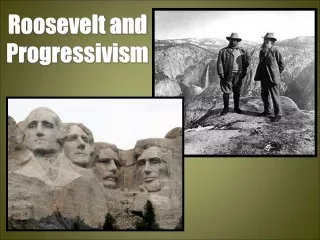
Roosevelt and Progressivism
DESCRIPTION
Roosevelt and Progressivism. Chapter 22 Section 1. Political machines gain power throughout 1890’s, controlling cities and state governments. Big corporations also gain power over economy and government . Rise of Progressivism. Individuals organize to reform these issues.
Download

1 / 0
Download Presentation

Télécharger la présentation
Roosevelt and Progressivism
An Image/Link below is provided (as is) to download presentation
Download Policy: Content on the Website is provided to you AS IS for your information and personal use and may not be sold / licensed / shared on other websites without getting consent from its author.
Content is provided to you AS IS for your information and personal use only.
Download presentation by click this link.
While downloading, if for some reason you are not able to download a presentation, the publisher may have deleted the file from their server.
During download, if you can't get a presentation, the file might be deleted by the publisher.
E N D
Presentation Transcript
-
Roosevelt and Progressivism
Chapter 22 Section 1 - Political machines gain power throughout 1890’s, controlling cities and state governments. Big corporations also gain power over economy and government Rise of Progressivism
- Individuals organize to reform these issues. Most were native born and middle class. The reformers and their movements came to be called progressivism. Progressivism
- Around 1900, groups of writers are going to expose corruption to society. These writers were known as muckrakers. Muckrakers and progressives shared 3 goals: - reform government & expand democracy - promote social welfare - create economic reform Muckrakers
- Who could be considered present day muckrakers? Present Day Muckrakers
- 1870s and 1880s, elected officials typically hand out government jobs and contracts, known as patronage. To reform this, government passes Pendleton Civil Service Act (1883). Act requires people to take civil service exams for certain government jobs. Government Reforms
- In order to give voters more control over government, a direct primary was established. Direct primaries allowed voters to select candidates to run for office, rather than party conventions. Expanding Democracy
- 3 other reforms were also proposed: Initiative: allowed voters to propose a law directly. Referendum: proposed law was submitted for vote by the people. Recall: allowed people to vote an official out of office. Expanding Democracy
- Goals were to address issues of poverty, unemployment, poor working conditions. Who were some of the social reformers from chapter 21? Social Welfare
- Hull House member who pushes for minimum wage laws and limits on women’s working hours. Florence Kelley
- Progressive goal of limiting power of big business and regulating activities (trusts). Trusts would work together to cut prices, eliminate competitors, and then raise prices. Economic Reform
- Made it illegal for corporations to form trusts and control and industry. Government was unable to enforce the law at first. Sherman Antitrust Act (1890)
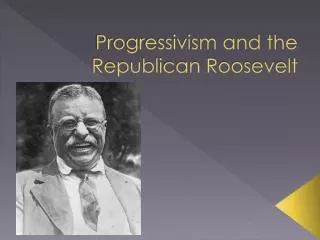
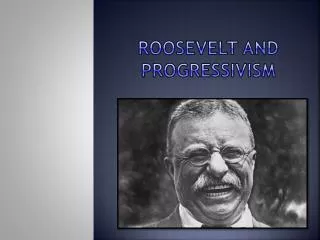
- Republican vice president who gains presidency after McKinley is shot. Saw gov. as an “umpire,” regulating business out of public interest Theodore Roosevelt
- Roosevelt finally enforced the Sherman Antitrust Act. Prior to Roosevelt, businesses mainly ignored the law. First target was the railroads, followed by Standard Oil and tobacco trusts. Roosevelt’s Enforcement
- After reading Upton Sinclair’s The Jungle, Roosevelt launches investigation in meat packing industry. Signs Meat Inspection Act (1906) and the Pure Food and Drug Act, banning sales of impure foods and medicines. Roosevelt Leads Reforms
- Although Roosevelt pushes for reforms, he leaves out African Americans. He believed it to be morally wrong, but did not take political risk. Discrimination
- Roosevelt was an avid hunter and outdoorsman. Felt nature was gradually losing resources. Preserves over 200 million acres. Conservation
-
Taft & Wilson as Progressives
Section 2 - Eugene V. Debs runs for president in 1908. Many Americans are frustrated with capitalism. Debs earns 420,000 votes under the Socialist Party. Capitalism vs Socialism
- Debs ran against Republican William H. Taft and Democrat William Jennings Bryan Taft promised to follow Roosevelt’s reforms and progressive ideology. William Howard Taft
- Taft continued to attack trusts (twice as many as Roosevelt). However, he receives little credit as he joins with conservative Republicans. Taft does pass two amendments.
- Passed in 1909 and ratified in 1913. Gave Congress power to create income taxes. Intended to spread cost of government to more people. Sixteenth Amendment
- Ratified in 1913 Allowed for direct election of US Senators Prior to 17th Amendment, state legislatures chose Senators. Seventeenth Amendment
- Republicans are split on Roosevelt and Taft. Roosevelt breaks off and forms Progressive Party (Bull Moose Party). Democrats chose Woodrow Wilson The divide in Republicans stole votes from Taft, allowing Wilson to win the election. Election of 1912
- Thought government should break up monopolies. Also thought government should help workers in their struggle against business owners. Wilson Presidency
- Businesses could no longer buy stock of a competitor. Clayton Act was also prolabor: Labor unions and farm organizations could merge and expand Limited courts on ending strikes Legalized strikes, picketing, and boycotts Clayton Antitrust Act (1914)
- Improved nations monetary and banking system Federal Reserve Board oversees 12 regional Reserve banks. Creates more flexible currency system, allowing banks to control money supply through interest rates. Federal Reserve Act (1913)
- Regional Reserve Banks (12)
- Wilson does little for African American civil rights He actually segregates the federal government Wilson, Taft, and Roosevelt do not push for civil rights, despite being “progressives”. Wilson’s Discrimination
- Rise of KKK (1915) Silent, black & white film portraying whites & the KKK as “heroes” of Reconstruction. KKK saved white women from African American attackers
- “Prohibition Amendment” Reformers thought alcohol ban would reduce poverty. Business leaders felt it made workers less efficient Eighteenth Amendment
- Congress finally passes in 1917 Prohibited manufacture and sale of alcoholic beverages States ratified amendment in 1919 Passage of 18th Amendment
- 3prolabor reforms of Clayton Antitrust Act. What was the main purpose of the Federal Reserve? Review


More Related

Audio
Live Player