Download
1 / 1
10 likes | 125 Vues
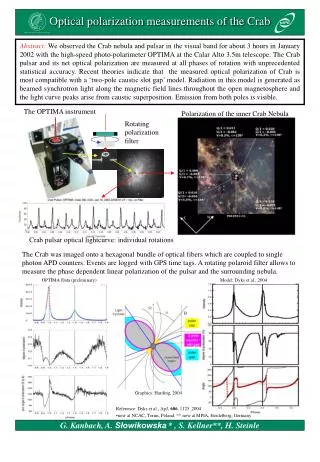
In January 2002, we conducted extensive optical observations of the Crab Nebula and Pulsar over three hours using the OPTIMA photo-polarimeter at the Calar Alto 3.5m telescope. This study achieved unprecedented statistical accuracy in measuring the Crab pulsar's optical polarization at all rotational phases. Our findings suggest that the polarization characteristics align closely with the 'two-pole caustic slot gap' model, indicating emission from both poles and synchronously varying light curves due to caustic superposition. The study employs advanced techniques such as a rotating polarizer and single photon detection.

E N D
Optical polarization measurements of the Crab Model: Dyks et al., 2004 Abstract: We observed the Crab nebula and pulsar in the visual band for about 3 hours in January 2002 with the high-speed photo-polarimeter OPTIMA at the Calar Alto 3.5m telescope. The Crab pulsar and its net optical polarization are measured at all phases of rotation with unprecedented statistical accuracy. Recent theories indicate that the measured optical polarization of Crab is most compatible with a ‘two-pole caustic slot gap’ model. Radiation in this model is generated as beamed synchrotron light along the magnetic field lines throughout the open magnetosphere and the light curve peaks arise from caustic superposition. Emission from both poles is visible. The OPTIMA instrument Polarization of the inner Crab Nebula Rotating polarization filter Crab pulsar optical lightcurve: individual rotations The Crab was imaged onto a hexagonal bundle of optical fibers which are coupled to single photon APD counters. Events are logged with GPS time tags. A rotating polaroid filter allows to measure the phase dependent linear polarization of the pulsar and the surrounding nebula. OPTIMA Data (preliminary) Graphics: Harding, 2004 • Reference: Dyks et al., ApJ, 606, 1125 ,2004 • now at NCAC, Torun, Poland, ** now at MPIA, Heidelberg, Germany G. Kanbach, A. Słowikowska * , S. Kellner**, H. Steinle