Understanding LCM and GCF: Key Concepts for Homework Success
This guide explains the relationship between the Least Common Multiple (LCM) and Greatest Common Factor (GCF) of numbers, emphasizing that every set of numbers has an LCM, while the GCF can be 1 if no common factors exist. It also covers methods for finding LCM, including using multiples and dividing the product of numbers by their GCF. An illustrative example is provided with the numbers 4, 6, and 8 to clarify the concepts further. Additionally, it introduces keywords that help translate word problems into mathematical expressions.

Understanding LCM and GCF: Key Concepts for Homework Success
E N D
Presentation Transcript
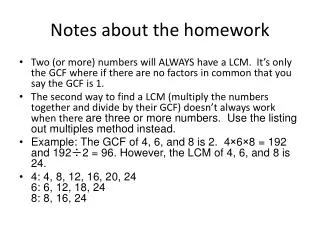
Notes about the homework • Two (or more) numbers will ALWAYS have a LCM. It’s only the GCF where if there are no factors in common that you say the GCF is 1. • The second way to find a LCM (multiply the numbers together and divide by their GCF) doesn’t always work when there are three or more numbers. Use the listing out multiples method instead. • Example: The GCF of 4, 6, and 8 is 2. 4×6×8 = 192 and 192÷2 = 96. However, the LCM of 4, 6, and 8 is 24. • 4: 4, 8, 12, 16, 20, 246: 6, 12, 18, 248: 8, 16, 24
Key words that tell us to subtract • Notice how for the last three, you have to switch the order when you turn it into math.