Understanding Temperature and Ideal Gases: Key Concepts and Thermal Equilibrium
150 likes | 275 Vues
This comprehensive overview covers essential concepts related to temperature, ideal gases, and thermal equilibrium. Topics include the definition and measurement of temperature on various scales (Kelvin, Celsius, and Fahrenheit), principles of thermal expansion, and calculations involving the behavior of ideal gases. Key equations, such as PV = NT and the relationship between volume and temperature, are explained. The importance of thermal equilibrium, where heat transfers between objects until they reach the same temperature, is emphasized. This resource is ideal for students studying thermodynamics and gas laws.


Understanding Temperature and Ideal Gases: Key Concepts and Thermal Equilibrium
E N D
Presentation Transcript
13 Temperature and Ideal Gases • Homework: • Problems: 1, 7, 41. • Thermal Equilibrium • Temperature Scales • Ideal Gases • Thermal Expansion
Temperature T ~ avg. KE/molecule Thermal Expansion Scales: Kelvin, K C° = K – 273 F° = (9/5)C° + 32 2
Thermal Equilibrium • Heat flows from hotter object to cooler object. • When the heat flow ceases the objects are in thermal equilibrium. • Objects in thermal equilibrium are at the same temperature. • /
Gas Thermometer • PV ~ NT • P ~ T (V, N constant) • Gas cools, • avg. KE 0, • (absolute zero), • P 0, • ≈ -273 °C
Constant Pressure • What % increase in V occurs for an ideal gas heated from 20C to 40C? (V ~ T) • (It does not double, b/c C is not a thermodynamic temperature scale) • V2/V1 = T2/T1 = (273+40)/(273+20) = 1.068 • 6.8% increase in volume.
Linear Thermal Expansion DL = a LoDT Example: 100C increase in Aluminum causes a fractional increase in length of 0.0024 = 0.24% change.
Summary • Thermal Equilibrium • Temperature Scales • Ideal Gases • Thermal Expansion
Water Expansion Expansion from 4°Cto 100°C (normal) Contraction from 0°C to 4°C. (anomalous, transient ice melting) 10 10
11 11
Superheating Mythbusters 12 12
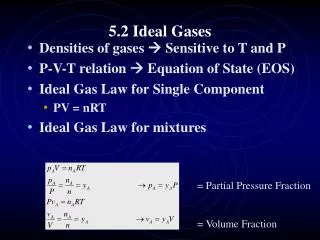
Ideal Gases • N molecules (few intermolecular collisions) • v = average speed • P due to wall-collisions (P ~ Nv/t) • t = time between same-wall collision