Understanding Temporal Trajectories: An OWL Time Analysis of Positions and Moving Objects
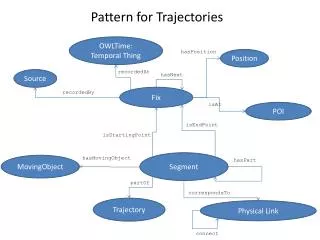
This documentation explores the OWLTime framework for analyzing temporal trajectories of moving objects. It delineates how positions are recorded, linked to sources, and associated with points of interest (POIs). It describes the role of segments in defining start and end points, the relationship between trajectories and moving objects, and how physical links connect these elements. By employing this structured model, we can gain insights into motion patterns and temporal relationships, relevant for applications in various fields such as transportation, logistics, and urban planning.

Understanding Temporal Trajectories: An OWL Time Analysis of Positions and Moving Objects
E N D
Presentation Transcript
Pattern forTrajectories OWLTime: Temporal Thing hasPosition Position recordedAt Source hasNext Fix recordedBy isAt POI isEndPoint isStartingPoint Segment hasMovingObject MovingObject hasPart partOf correspondsTo Trajectory Physical Link connect