Kinematic and Motion
210 likes | 345 Vues
This document covers the fundamental concepts of motion, including linear and angular mechanics. It provides equations and examples for calculating acceleration, distance, and velocity in various scenarios: a sports car reaching 100 km/h, an object falling from a building, and the angular velocity of a gear. Detailed calculations illustrate angular acceleration of electric motors and flywheel motion, enhancing the comprehension of complex mechanical systems and their behavior under different conditions.


Kinematic and Motion
E N D
Presentation Transcript
Kinematic and Motion KJS 2233 Mechanic of Machine
Type of Motions • Linear • Angular
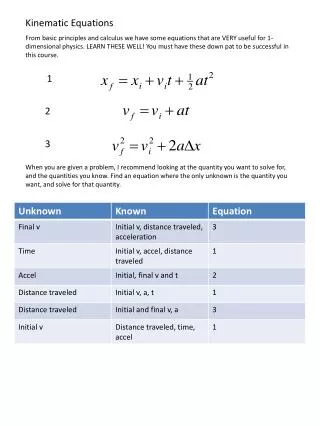
Linear Motion • Equations
Example a)Determine the acceleration of a sport car if time taken to hit 100 km/h is 5 second. b)Determine the distance from starting point to achieve 100 km/h
answer a) 5.5 m/s2 b) 69.75m
Example • An object fall from a building, determine its velocity after 1s and 2s.
answer • 9.81 m/s • 19.62 m/s
Angular Motion Equations
Example A gear rotates counter clock wise at constant speed. It moves 300O in 0.5 s. Determine its angular velocity.
Answer = 100 rpm
Example The mechanism below show the component used in exhaust port of internal combustion engine. Cam forces rocker arm at point B with velocity of 30mm/s. Determine angular velocity of angular plate and velocity at point C.
Answer W2= vb/rb =30/20 = 1.5 rad/s • Vc= rw • =15 mm x 1.5 rad/s • =22.5 mm/s
Example An electric motor will speed up to 1800 rpm in 2 s when the power is turned on. Assuming the speed up is at constant rate. Determine the angular acceleration of motor. Also determine the number of revolutions that the wheel spins before it is at full speed.
answer 188.6 rad or 30 revolutions
Answer Rev= 82 rev
Example A flywheel with diameter of 200 mm accelerates from 2000 rpm to 6000 rpm within 10 s. Determine its tangent and normal acceleration.
Answer • Answer; • 2000 rpm= 209.44 rad/s • 6000 rpm= 628.32 rad/s • 𝜶=41.892 • at = (41.892)x( 0.1)=4.1 • At 2000 rpm • an= (209.44)2x(0.2) • = 8773.02 m/s2 • At 6000 rpm • an= (628.32)2x(0.2) • = 78957.2 m/s2