Parallelograms
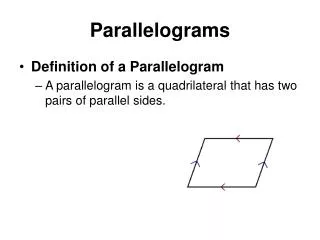
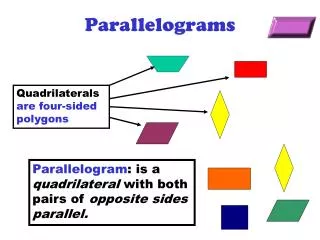
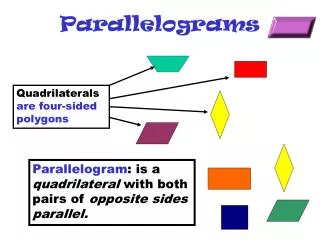
This guide explores the essential properties of parallelograms, including that opposite sides are congruent and parallel. Additionally, it explains that adjacent angles are supplementary, adding up to 180 degrees, and how the diagonals bisect each other. It also introduces related shapes like rectangles, squares, and rhombuses. Guidance on calculating the area using the height and base is provided, along with reliable sources for further study. Perfect for students seeking to enhance their geometry knowledge!

Parallelograms
E N D
Presentation Transcript
Parallelograms By Cassie, Hannah, Rachel, and Rebecca
Adjacent angles (angles next to one another) are supplementary (they add up to 180 degrees) Property 4 Y X X+Y=180 X Y
The diagonals of a parallelogram bisect each other. Property 5
Other Parallelograms Rectangles Squares Rhombuses
B(base) * H(height) How to find the area Height Base
Sources • http://www.coolmath.com/reference/parrallelograms.html • http://www.ies.co.jp/math/products/geo1/applets/para/para.html