Raspberry Pi Performance Benchmarking
This report delves into the performance benchmarking of Raspberry Pi clusters, focusing on model B with a 700MHz Broadcom ARM11 CPU, capable of being overclocked up to 1000MHz. We discuss the setup of a cluster using tools like MPI and ATLAS for enhancing linear algebra operations such as General Matrix Multiplication (GEMM). Our analysis includes performance measures such as FLOPS and demonstrates the impact of hardware tuning, memory allocation, and software optimization. Ultimately, we conclude that performance is significantly influenced by matrix and block size, RAM, and CPU speed.

Raspberry Pi Performance Benchmarking
E N D
Presentation Transcript
Raspberry Pi Performance Benchmarking Justin Moore Salish Kootenai College
Overview • Raspberry Pi Cluster Build • Performance • Performance Benchmark Tools • Tuning • Analysis • Conclusion
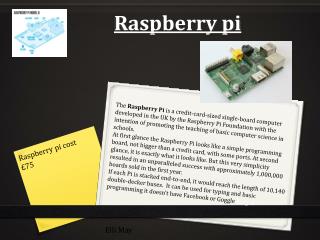
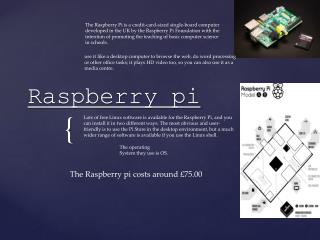
Raspberry Pi Cluster – Model B • CPU – Broadcom ARM11 76JZF-S 700MHz • Can overclock to 1000MHz • RAM – 512MB • 448MB/64MB – CPU/GPU • Linux OS • 10/100 BaseT Ethernet port • Size of a credit card • Price - $35 • Image: http://commons.wikimedia.org/wiki/File:RaspberryPi.jpg#mediaviewer/File:RaspberryPi.jpg
Raspberry Pi Cluster - Setup • Router – Western Digital N750 • NFS mounted external hard drive – 500GB Buffalo Inc. • 4 Pi cluster • USB hub – Manhattan 7 port USB 2.0 • SD card – Kodak 8GB
Performance – Floating Point Operations • How wemeasure performance • Busy CPU? Speed? • What is a floating point operation (FLOP)? • Arithmetic operation • Formats • Single • Double • Performance measurement by FLOPS • How do we measure FLOPS? • General Matrix Multiplication (GEMM) • High computational intensity with an increase in matrix size
Performance Benchmarking • Single Raspberry Pi • BLAS - Basic Linear Algebra Subprograms • ATLAS - Automatically Tuned Linear Algebra Software • Auto tunes BLAS for any system • Raspberry Pi Cluster • MPI - Message Passing Interface • Standard API for inter-process communication • Facilitates parallel programming • MPICH 2-1.4.1p1 • HPL - High Performance LINPACK • Tuned MPI • Combined with ATLAS • Wrote Custom code • ATLAS • Added parallel capability • Compared with HPL
MyGEMM – Naïve Implementation = * B (k,j) C (i,j) A(i,k) Where N = Matrix Size For i = 1 to N For j = 1 to N For k = 1 to N C(i,j)=C(i,j)+A(i,k)*B(k,j)
MyGEMM– Naïve Pitfalls • GEMM – Naïve method inefficient • Two whole matrices are loaded in to memory • Cache is not used efficiently • Strides through the matrix • If not Naïve, then what? Naïve
MyGEMM – Software Tuning • What is block matrix multiplication • Matrix is split into smaller matrices/blocks • Shrinks matrix size to allow both A & B into fast memory A13 A11 A12 A14 A21 A22 A23 A24 a12 a11 A31 A32 A34 A11 A33 a21 a22 A41 A42 A43 A44
MyGEMM – Cluster Software Tuning • How do we distribute the matrix multiplication? • MPI used to distribute blocks to nodes • MyGEMM allows for experimentation on block size A13 A11 A12 A14 Node 1 Node 2 A21 A22 A23 A24 A31 A32 A34 A33 A41 A42 A43 A44 Node 4 Node 3
Hardware Tuning • Raspberry Pi allows CPU overclocking and memory sharing between CPU and GPU • Memory • Memory is shared between CPUand GPU • 512MB total onboard memory • Up to 496MB can be used for CPU • More memory = larger matrices • CPU Clock • Up to 1000 MHz from 700MHz
Conclusion • Performance is dependent on key factors • Matrix Size • Block Size • RAM size • CPU speed • Top 500 – 1993 • T#292 • Tied with General Motors
Thank You • Dr. Richard Loft • Raghu Raj Prasanna Kumar • AmoghSimha • Stephanie Barr