Understanding Minerals: Characteristics, Properties, and Identification Techniques
Explore the fascinating world of minerals, defining their essential characteristics: natural, inorganic, crystalline, with a definite chemical composition, and solid. Discover the physical properties that aid in their identification, including color, streak, hardness, cleavage, fracture, and luster. Furthermore, delve into specialized properties like magnetism, double refraction, fluorescence, phosphorescence, and piezoelectricity. Learn various identification tests such as hardness and acid tests for carbonates. Gain a comprehensive understanding of minerals, their significance, and how they shape our world.

Understanding Minerals: Characteristics, Properties, and Identification Techniques
E N D
Presentation Transcript
What is a mineral?Mineral Characteristics shared by all minerals: • 1. Natural • occurs naturally • NOT manmade
What is a mineral? • 1. Natural • 2. Inorganic • Is not alive • Was never alive
What is a mineral? • 1. Natural • 2. Inorganic • 3. Crystalline • Atoms are arranged in an orderly pattern
What is a mineral? • 1. Natural • 2. Inorganic • 3. Crystalline • 4. Definite chemical composition • Chemical formula • SiO2 is Quartz
What is a mineral? • 1. Natural • 2. Inorganic • 3. Crystalline • 4. Definite chemical composition • 5. Solid • Not a gas, not a liquid
How will we remember this? • Natural • Inorganic • Crystalline • Definite chemical composition • Solid
Mineral Characteristics shared by all minerals:Now ICan Define mineralS! • Natural • Inorganic • Crystalline • Definite chemical composition • Solid
B. Physical Properties of Minerals • 1. Color • First impression • Not very reliable because lots of minerals can occur in many different colors
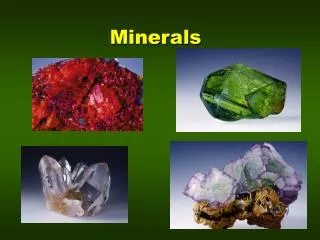
Quartz • Purple Amethyst
Clear • Blue • Green • Purple Fluorite
Physical Properties of Minerals • 1. Color • 2. Streak • The TRUE color of a mineral • Color of a mineral’s powder
Streak Minerals with a hardness greater than “7” usually don’t create a streak on the streak plate because they are harder than the Porcelain tile (unless the streak plate is specially made).
Physical Properties of Minerals • 1. Color • 2. Streak • 3. Hardness • A mineral’s resistance to being scratched • Mohs Hardness Scale from 1-10 Hardness depends on how “tightly packed” the atoms are
Mohs Hardness Scale Softest • Talc • Gypsum • Calcite • Fluorite • Apatite • Potassium feldspar • Quartz • Topaz • Corundum • Diamond Hardest
Physical Properties of Minerals • 1. Color • 2. Streak • 3. Hardness • 4. Cleavage • Splits along definite planes
“Cleav” = to split Cleaver
Physical Properties of Minerals • 1. Color • 2. Streak • 3. Hardness • 4. Cleavage • 5. Fracture • Breaks irregularly, jagged edges
Physical Properties of Minerals • 1. Color • 2. Streak • 3. Hardness • 4. Cleavage • 5. Fracture • 6. Luster • How light shines off a mineral • Metallic or Nonmetallic
Metallic Nonmetallic Luster
Physical Properties of Minerals:Used for Identification (I.D.) • Color • Streak • Hardness • Cleavage • Fracture • Luster
C. Special Properties • 1. Magnetism • Attracted to a magnet • Contains IRON, cobalt, or nickel
Special Properties • 1. Magnetism • 2. Double refraction • Looking through it, you see “double” • Ex. Calcite
Special Properties • 1. Magnetism • 2. Double refraction • 3. Fluorescence • Glows under ultraviolet (UV) light
Special Properties • 1. Magnetism • 2. Double refraction • 3. Fluorescence • 4. Phosphorescence • Continues to glow even after the UV light has been removed
Special Properties • 1. Magnetism • 2. Double refraction • 3. Fluorescence • 4. Phosphorescence • 5. Piezoelectric • Electricity is generated from Pressure • Example: Quartz
Special Properties • Magnetism • Double refraction • Fluorescence • Phosphorescence • Piezoelectric
D. Identification Tests • 1. Hardness • 2. Streak (True Color) • 3. Acid Test • Use hydrochloric acid • Tests for carbonate (calcite)
Caves can form in rocks with calcite, like here in Harrisonburg! Acid in groundwater dissolves the calcite