SlideServe
Menu
Préférences
© SlideServe · v2026

Simplicity in Complexity

cathy avatar
46 diapositives · 685 Views · Aug 11, 2014

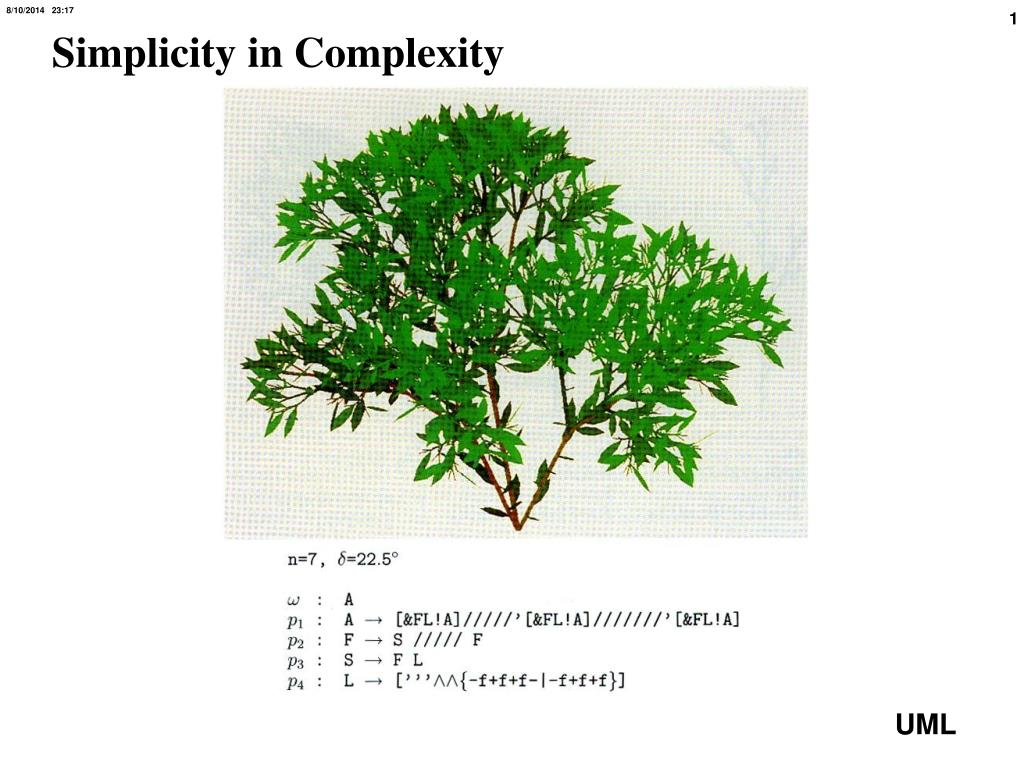
Simplicity in Complexity. Rewriting Systems Classic Example: Koch 1905. Initiator. Generator. Rewriting Systems: Formal Grammars. Best understood rewriting systems are those that operate on character strings Chomsky 1956: formal grammars applied to natural languages
Simplicity in Complexity - slide 1
01 / 46Simplicity in Complexity
1 / 17

Télécharger la présentation

Simplicity in Complexity
Une image / un lien ci-dessous est fourni (tel quel) pour télécharger la présentation

Politique de téléchargement : le contenu du site vous est fourni TEL QUEL pour votre information et votre usage personnel ; il ne peut être vendu, concédé sous licence ni partagé sur d’autres sites sans l’accord de son auteur.Le contenu vous est fourni TEL QUEL, pour votre information et votre usage personnel uniquement. Téléchargez la présentation en cliquant sur ce lien. Lors du téléchargement, si vous ne parvenez pas à télécharger une présentation, l’éditeur a peut-être supprimé le fichier de son serveur.Pendant le téléchargement, si vous ne parvenez pas à obtenir une présentation, le fichier a peut-être été supprimé par l’éditeur.

F I N

Plus de contenu associé

Transcription de la présentation
  1. Simplicity in Complexity

  2. Rewriting SystemsClassic Example: Koch 1905 Initiator Generator

  3. Rewriting Systems:Formal Grammars • Best understood rewriting systems are those that operate on character strings • Chomsky 1956: formal grammars applied to natural languages • Backus & Naur 1959: rewriting notation applied to formal definition of programming language (ALGOL-60) • Lindenmayer 1968 introduced a new type of rewriting system, subsequently termed L-systems • Essential difference between Chomsky grammars and L-systems is that in L-systems productions are applied in parallel.

  4. Deterministic, Context Free L-Systems (DOL) Grammar: Derivation:

  5. Formal Definition of L-System 100% Real Math

  6. Formal Definition of Derivation 100% Real Math

  7. Turtle Interpretation of StringsAbelson & diSessa (MIT 1982) The state of the turtle is defined as an ordered triplet, where the cartesian coordinates represent the turtle’s position, and the angle a, called the heading, is interpreted as the direction in which the turtle is facing. Where am I? a

  8. Turtle Interpretation of Character String Character Interpretation F f + -

  9. Turtle Interpretation of a String String: FFF-FF-F-F+F+FF-F-FFF d = 90 - +

  10. Example of Turtle Interpretation:Quadratic Koch Island The L-System:

  11. Sequence of Koch Curves Obtained byModification of Production Successor

  12. General Edge Rewriting The Koch constructions are a restricted case of general edge rewriting, where there can be more than one edge letter, interpreted by the turtle as “move forward”. Examples:

  13. Example of FASS Curves Generated byEdge-rewriting FASS = space-filling, self-avoiding, simple, and self-similar

  14. Node Rewriting:Turtle Interpretation Aligned with turtle state here: Turtle resumes here: Subfigure A PA QA

  15. Node Rewriting Example:Hilbert Curve

  16. U H L Modeling in Three Dimensions

  17. Symbols to Control Turtle Orientation in Space Symbol Turtle Semantics + Turn left by angle d, using rotation matrix Ru(d) - Turn right by angle d, using rotation matrix Ru(-d) & Pitch down by angle d, using rotation matrix RL(d) ^ Pitch up by angle d, using rotation matrix RL(-d) \ Roll left by angle d, using rotation matrix RH(d) / Roll right by angle d, using rotation matrix RH(-d)

  18. Three Dimensional Hilbert Curve

  19. Branching Structures:Axial Trees • At each node at most one outgoing straight segment is distinguished • The first segment in the sequence originates at the root of the tree or as a lateral segment at some node • Each subsequent segment is a straight segment • The last segment is not followed by any straight segments

  20. Tree OL-Systems e d e d c s b c s b a a Production T1 T2

  21. Bracketed OL-Systems Turtle semantics: [ Push the current state of the turtle onto a stack. The information saved contains the turtle’s position and orientation, and possibly other attributes such as color, segment width ] Pop a state from the state and make it the current state of the turtle. No line is drawn, although in general the position of the turtle changes Example: d=45 F[+F][-F[-F]F]F[+F][-F]

  22. Plant-Like Structures Generated byBracketed OL-Systems

  23. Plant-Like Structures Generated byBracketed OL-Systems

  24. Three Dimensional Bracketed OL-System

  25. Stochastic OL-Systems 0.34 0.33 0.33

  26. Example of Stochastic DOL-System

  27. Parametric DOL-Systems Formal Parameters Actual Parameters Module Condition L-System: Derivation:

  28. Parametric DOL Systems • A production matches a nodule in a parametric word if the following conditions are met: • The letter in the module and the letter in the production predecessor are the same • The number of actual parameters in the module is equal to the number of formal parameters in the production predecessor • The condition evaluates to true if the actual parameter values are substituted for the formal parameters in the production

  29. Turtle Interpretation of Parametric Words If one or more parameters are associated with a symbol interpreted by the turtle, the value of the first parameter controls the turtle’s state. If the symbol is not followed by any parameters, default values specified ooutside the L-system are used as in the non-parametric case. The basic set of symbols affected by the introduction of parameters is listed below: F(a) Move forward a step of length a > 0. f(a) Move forward a step of length a without drawing a line +(a) Rotate around U by an angle of a degrees &(a) Rotate around L by an angle of a degrees /(a) Rotate around H by an angle of a degrees

  30. Example of Textures and Parametric Surface Models

  31. Developmental Surface Models Consider the following L-system:

  32. Fern Drawn Using Leaves Specified byPrevious L-System

  33. Alternative Notation for Polygon Drawing

  34. Parametric L-Systems Produce Varying Leaf Structures

  35. Rose Leaves Generated by L-System ofPrevious Slide

  36. Parametric L-System Used to GenerateCompound Leaves

  37. Examples of Compound Leaves Generated byL-System of Slide 38

  38. Examples of Compound Leaves Generated byL-System of Slide 38

  39. General Branching Patterns • Terminal: main apex and all lateral apices terminate • Sympoidal: main apex terminates; some lateral apices continue • Monopoidal: main apex continues; all lateral apices terminate • Polypoidal: main apex continues; some lateral apices also continue

  40. Inflorescences: Compound Flowering StructuresRacemes: Monopoidal Inflorscences Generating Partial L-System: L: leaf I: Internode K: Flower

  41. Pattern of Simple Racemes

  42. Lily-of-the-ValleyExample of Simple Raceme

  43. Development of Raceme:Capsella Bursa-Pastoris

  44. L-System Generating Capsella Bursa-Pastoris