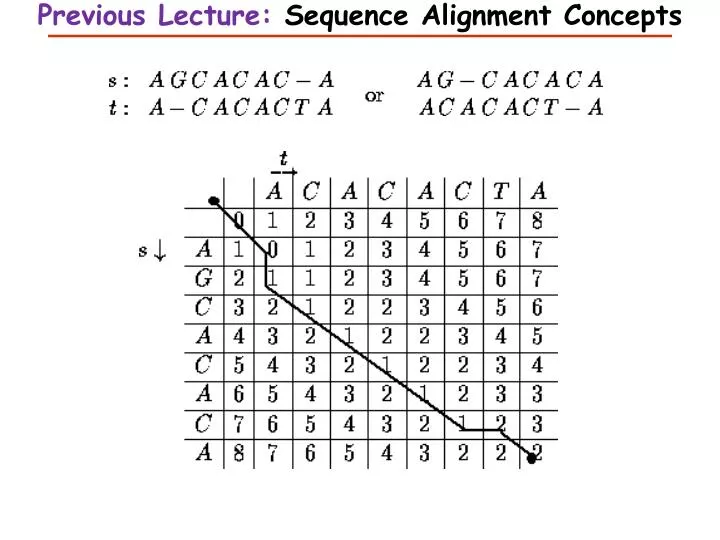
Previous Lecture: Sequence Alignment Concepts
Previous Lecture: Sequence Alignment Concepts. This Lecture. Introduction to Biostatistics and Bioinformatics Sequence Database Searching. Stuart M. Brown, Ph.D. Center for Health Informatics and Bioinformatics NYU School of Medicine. BLAST Searches GenBank (or a custom database).

Previous Lecture: Sequence Alignment Concepts
E N D
Presentation Transcript
This Lecture Introduction to Biostatistics and Bioinformatics Sequence Database Searching Stuart M. Brown, Ph.D. Center for Health Informatics and BioinformaticsNYU School of Medicine
BLAST Searches GenBank(or a custom database) [BLAST= Basic Local Alignment Search Tool] The NCBI BLASTweb server lets you compare your query sequence to various sections of GenBank: • nr = non-redundant (main sections) • month = new sequences from the past few weeks • ESTs • human, drososphila, yeast, or E.coli genomes • proteins (by automatic translation) • This is a VERY fast and powerful computer.
BLAST • Uses word matching • Similarity matching of words (3 aa’s, 11 bases) • does not require identical words. • If no words are similar, then no alignment • won’t find matches for very short sequences • “gapped BLAST” (BLAST 2) improved handling of gaps in alignment • BLAST searches can be sent to the NCBI’s server from website, or a custom client program (Unix)
BLAST Word Matching MEAAVKEEISVEDEAVDKNI MEA EAA AAV AVK VKE KEE EEI EIS ISV ... Break query into words: Break database sequences into words:
Database Sequence Word Lists RTT AAQ SDG KSS SRW LLN QEL RWY VKI GKG DKI NIS LFC WDV AAV KVR PFR DEI … … Query Word List: MEA EAA AAV AVK VKL KEE EEI EIS ISV Compare Word Lists ? Compare word lists by Hashing (allow near matches)
Find locations of matching words in database sequences ELEPRRPRYRVPDVLVADPPIARLSVSGRDENSVELTMEAT • MEA • EAA • AAV • AVK • KLV • KEE • EEI • EIS • ISV TDVRWMSETGIIDVFLLLGPSISDVFRQYASLTGTQALPPLFSLGYHQSRWNY IWLDIEEIHADGKRYFTWDPSRFPQPRTMLERLASKRRVKLVAIVDPH
BLAST 2algorithm • The NCBI’s BLAST website and GCG (NETBLAST) now both use BLAST 2 (also known as “gapped BLAST”) • This algorithm is more complex than the original BLAST • It requires two word matches close to each other on a pair of sequences (i.e. with a gap) before it creates an alignment
Gapped BLAST HVTGRSAF_FSYYGYGCYCGLGTGKGLPVDATDRCCWA Seq_XYZ: QSVFDYIYYGCYCGWGLG_GK__PRDA Query: E-val=10-13 • Use two word matches as anchors to build an alignment between the query and a database sequence. • Then score the alignment.
HSPs are Aligned Regions • The results of the word matching and attempts to extend the alignment are segments - called HSPs (High-scoring Segment Pairs) • BLAST often produces several short HSPs rather than a single aligned region
>gb|BE588357.1|BE588357 194087 BARC 5BOV BostauruscDNA 5'. • Length = 369 • Score = 272 bits (137), Expect =4e-71 • Identities = 258/297 (86%), Gaps = 1/297 (0%) • Strand = Plus / Plus • Query: 17 aggatccaacgtcgctccagctgctcttgacgactccacagataccccgaagccatggca 76 • |||||||||||||||| | ||| | ||| || ||| | |||| ||||| ||||||||| • Sbjct: 1 aggatccaacgtcgctgcggctacccttaaccact-cgcagaccccccgcagccatggcc 59 • Query: 77 agcaagggcttgcaggacctgaagcaacaggtggaggggaccgcccaggaagccgtgtca 136 • |||||||||||||||||||||||| | || ||||||||| | ||||||||||| ||| || • Sbjct: 60 agcaagggcttgcaggacctgaagaagcaagtggagggggcggcccaggaagcggtgaca 119 • Query: 137 gcggccggagcggcagctcagcaagtggtggaccaggccacagaggcggggcagaaagcc 196 • |||||||| | || | ||||||||||||||| ||||||||||| || |||||||||||| • Sbjct: 120 tcggccggaacagcggttcagcaagtggtggatcaggccacagaagcagggcagaaagcc 179 • Query: 197 atggaccagctggccaagaccacccaggaaaccatcgacaagactgctaaccaggcctct 256 • ||||||||| | |||||||| |||||||||||||||||| |||||||||||||||||||| • Sbjct: 180 atggaccaggttgccaagactacccaggaaaccatcgaccagactgctaaccaggcctct 239 • Query: 257 gacaccttctctgggattgggaaaaaattcggcctcctgaaatgacagcagggagac 313 • || || ||||| || ||||||||||| | |||||||||||||||||| |||||||| • Sbjct: 240 gagactttctcgggttttgggaaaaaacttggcctcctgaaatgacagaagggagac 296
Similarity Search Statistics • Homework searches with Needleman-Wunsch and Smith-Waterman have shown problems with “score” functions • Score varies with length of sequences, gap penalties, composition, protein scoring matrix, etc. • Need an unbiased method to compare alignemnts and judge if they are “significant” in a biological sense
How to score alignments? • In a large database search, the scores of good alignments differ from random alignments. • Many are random, very few good ones. • This follows an extreme value distribution, not a normal distribution. So we need to use an appropriate statistical test.
Pearson: FASTA Statistics • http://people.virginia.edu/~wrp/talk95/prot_talk12-95_4.html
Compute p-value from the extreme value distribution E is the e-value (significance score, m is your query length, n is the length of a matching database sequence, S is the score (computed from a count of matching letters with a scoring matrix and gap penalty). K is a constant computed from the database size, lambda is a constant that models the scoring system.
BLASTStatistics • E() value is equivalent to a p value • Significant if E() < 0.05 (smaller numbers are more significant) • The E-value represents the likelihood that the observed alignment is due to chance alone. A value of 1 indicates that an alignment this good would happen by chance with any random sequence searched against this database. The official NCBI explanation of BLAST statistics by Stephen Altschul http://www.ncbi.nlm.nih.gov/BLAST/tutorial/Altschul-1.html
BLAST has Automatic Translation • BLASTX makes automatic translation (in all 6 reading frames) of your DNA query sequence to compare with protein databanks • TBLASTN makes automatic translation of an entire DNA database to compare with your protein query sequence • Only make a DNA-DNA search if you are working with a sequence that does not code for protein.
BLAST Results - Alignment >gi|17556182|ref|NP_497582.1| Predicted CDS, phosphatidylinositol transfer protein [Caenorhabditis elegans] gi|14574401|gb|AAK68521.1|AC024814_1 Hypothetical protein Y54F10AR.1 [Caenorhabditis elegans] Length = 336 Score = 283 bits (723), Expect = 8e-75 Identities = 144/270 (53%), Positives = 186/270 (68%), Gaps = 13/270 (4%) Query: 48 KEYRVILPVSVDEYQVGQLYSVAEASKNXXXXXXXXXXXXXXPYEK----DGE--KGQYT 101 K+ RV+LP+SV+EYQVGQL+SVAEASK P++ +G+ KGQYT Sbjct: 70 KKSRVVLPMSVEEYQVGQLWSVAEASKAETGGGEGVEVLKNEPFDNVPLLNGQFTKGQYT 129 Query: 102 HKIYHLQSKVPTFVRMLAPEGALNIHEKAWNAYPYCRTVITN-EYMKEDFLIKIETWHKP 160 HKIYHLQSKVP +R +AP+G+L IHE+AWNAYPYC+TV+TN +YMKE+F +KIET H P Sbjct: 130 HKIYHLQSKVPAILRKIAPKGSLAIHEEAWNAYPYCKTVVTNPDYMKENFYVKIETIHLP 189 Query: 161 DLGTQENVHKLEPEAWKHVEAVYIDIADRSQVL-SKDYKAEEDPAKFKSIKTGRGPLGPN 219 D GT EN H L+ + E V I+IA+ + L S D + P+KF+S KTGRGPL N Sbjct: 190 DNGTTENAHGLKGDELAKREVVNINIANDHEYLNSGDLHPDSTPSKFQSTKTGRGPLSGN 249 Query: 220 WKQELVNQKDCPYMCAYKLVTVKFKWWGLQNKVENFIHKQERRLFTNFHRQLFCWLDKWV 279 WK + P MCAYKLVTV FKW+G Q VEN+ H Q RLF+ FHR++FCW+DKW Sbjct: 250 WKDSVQ-----PVMCAYKLVTVYFKWFGFQKIVENYAHTQYPRLFSKFHREVFCWIDKWH 304 Query: 280 DLTMDDIRRMEEETKRQLDEMRQKDPVKGM 309 LTM DIR +E + +++L+E R+ V+GM Sbjct: 305 GLTMVDIREIEAKAQKELEEQRKSGQVRGM 334
BLASTalignments are short segments • BLAST tends to break alignments into non-overlapping segments • can be confusing • reduces overall significance score
BLAST is Approximate • BLAST makes similarity searches very quickly because it takes shortcuts. • looks for short, nearly identical “words” (11 bases) • It also makes errors • misses some important similarities • makes many incorrect matches • easily fooled by repeats or skewed composition
Web BLAST runs on a big computer at NCBI • Usually fast, but does get busy sometimes • Fixed choices of databases • problems with genome data “clogging” the system • ESTs are not part of the default “NR” dataset • Uses filtering of repeats • Graphical summary of output • Links to GenBank sequences
BLASTStatistics • E() value is equivalent to standard P value • Significant if E() < 0.05 (smaller numbers are more significant) • The E-value represents the likelihood that the observed alignment is due to chance alone. A value of 1 indicates that an alignment this good would happen by chance with any random sequence searched against this database.
Interpretation of output • very low E() values (e-100) are homologs or identical genes • moderate E() values are related genes • long list of gradually declining of E() values indicates a large gene family • long regions of moderate similarity are more significant than short regions of high identity
What program to use for searching? 1) Smith-Waterman is slower, but more sensitive • known as a “rigorous” or “exhaustive” search = optimal alignments • EMBOSS “water” program 2) FASTA • more sensitive for DNA-DNA comparisons • FASTXand TFASTX can find similarities in sequences with frameshifts 3) BLAST is fastest and easily accessed on the Web • limited sets of databases for web version • Free software to install on UNIX computers, make custom databases • nice translation tools (BLASTX, TBLASTN)
Borderline similarity • What to do with matches with E() values in the 0.5 -1.0 range? • this is the “Twilight Zone” • retest these sequences and look for related hits (not just your original query sequence) • similarity is transitive: if A~B and B~C, then A~C
Biological Relevance • It is up to you, the biologist to scrutinize these alignments and determine if they are significant. • Were you looking for a short region of nearly identical sequence or a larger region of general similarity? • Are the mismatches conservative ones? • Are the matching regions important structural components of the genes or just introns and flanking regions?
Database to Search • The biggest factor that affects the results of a similarity search, is …obviously… what database you search • Choose to search PROTEIN databases whenever possible • Smaller = less redundant = higher e-values • Non-identical letters have information (scoring matrix)
Comprehensive vs Annotated • It is NOT always best to search the biggest, most comprehensive database • What have you learned when your cloned sequence matches a "hypothetical gene?" • RefSeq is the best annotated DNA database • SwissProt is the best annotated protein database
What are you looking for? • Usually you want to search annotated genes • If you don't find anything, you might want to search ESTs (sequences of mRNA fragments) • ESTs are not included in the default "nr" GenBank database
Limit by species • If you know your sequence is from one species • Or you want to limit your search to just that species… • use the ENTREZ limits feature
Filters • BLAST is easily fooled by repeats and low complexity sequence (enriched in a few letters = DNA microsatellites, common acidic, basic or proline-rich regions in proteins) • Default filters remove low complexity from protein searches and known repeats (ie. Alu) from DNA searches • Removes the problem sequences before running the BLAST search • By default, filters are removed in final alignment (“lookup only”)
Size Matters • Short sequences can't get good e-values • What is the probability of finding a 12 base fragment in a "random" genome? 412= 16,777,216 (once per 16 million bases) • What length DNA fragment is needed to define a unique location in the genome? 416= 4,294,967,296 (4 billion bases) • So, what is the best e-value you can get for a 16 base fragment?
Word size • BLAST uses a default word size of 11 bases for DNA • Short sequences will have few words • Low quality sequence might have a sequencing error in every word • "MegaBlast" uses very large words (28) • allows for fast mRNA > genome alignment • allows huge sequences to be use as query • "Search for short, nearly exact matches" • word size = 7, expect = 1000
Batch BLAST • What if you need to do a LOT of BLAST searches? • NCBI www BLAST server will accept a FASTA file with multiple sequences • NCBI has a BLAST client program: blastcl3(Unix, Windows, and Mac) • NETBLAST is a scriptable BLAST client in GCG package
Lots of Results • Batch or acclerated BLAST searches produce lots of results files. • What to do with them? • BlastReport2 is a Perl script from NCBI to sort out results from a batch BLAST. "BlastReport2 is a perl script that reads the output of Blastcl3, reformats it for ease of use and eliminates useless information."
BLAST Parser • Hundreds of different people have written programs to sort BLAST results (including myself) • Better to use a common code base • BioPerl is a collection of public Perl modules including several BLAST parsers