The Dynamics of State Corporatism and Oligarchs in Russia's Political Landscape
This analysis explores state corporatism in Russia, where the state influences which interest groups partake in policy-making. Following the collapse of the USSR, insider privatization allowed oligarchs, often aligned with the government, to acquire state-owned assets. Mikhail Khodorkovsky, the former CEO of Yukos Oil Co., exemplifies the complex relationship between business and politics, facing imprisonment for opposing the regime. The entrenched corruption, highlighted by Russia's low ranking on Transparency International's index, reflects a political culture characterized by mistrust and the prioritization of loyalty over the rule of law.

The Dynamics of State Corporatism and Oligarchs in Russia's Political Landscape
E N D
Presentation Transcript
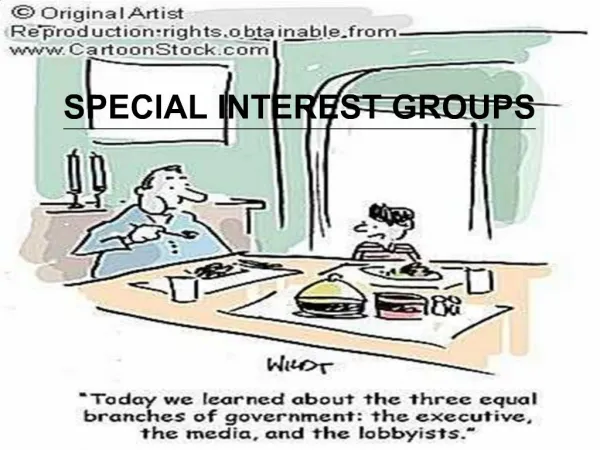
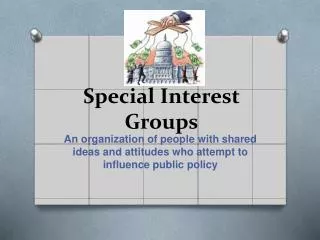
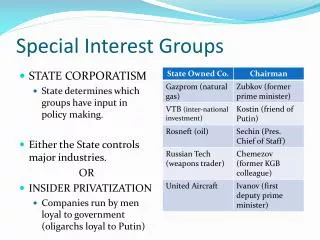
Special Interest Groups • STATE CORPORATISM • State determines which groups have input in policy making. • Either the State controls major industries. OR • INSIDER PRIVATIZATION • Companies run by men loyal to government (oligarchs loyal to Putin)
Russian Oligarchs • Tycoons that bought state-owned industries at a cheap price when USSR collapsed. • Many oligarchs came from nomenklatura. • Close ties to Yeltsin in 1990s.
Putin and the Oligarchs • Warned them to stay out of politics. • Political challengers were: • Jailed • Fled country • Pro-Putin Oligarchs • Insider Privatization
Mikhail Khodorkovsky • Richest man in Russia • CEO of Yukos Oil Co. • Funded opposition parties • 2003: 8-year sentence for fraud and tax evasion • 2011: 5 more years for stealing and laundering
Corruption, Law, & Order in Russia • “The regime Putin built was based on loyalty to him above the rule of law.” • Mikhail Trepashkin • Corruption: Ranks 154th out of 178 countries on Transparency International Report, 2010.
“Anti-Corruption Efforts in Russia Fall Short • Why do Russian authorities frame innocent people? • How much do Russians pay in bribes a year? • How do police officers advance in the department? • Why was Trespashkin fired from the FSB?
Russia’s Political Culture Basic values and assumptions that people have toward authority, the political system, and political life. • Mistrust of Government • Low legitimacy and political efficacy • Statism • Government plays an active, strong role in shaping society (political, economic, social, and military). • Equality of Result • Persists after communism • Low approval of oligarchs