Download
1 / 18
190 likes | 337 Vues
This case study explores the GCTBE Microfinance Project aimed at transitioning rural market women in Cameroon from the informal to the formal market sector. Through partnerships with local institutions, the program provides tailored training in business management, financial planning, and entrepreneurship to empower women entrepreneurs. Following a structured approach that includes grants, loans, and ongoing support, the initiative not only enhances business sustainability but also contributes to personal growth and community development. The program's outcomes show significant potential for replication in Sub-Saharan Africa.

E N D
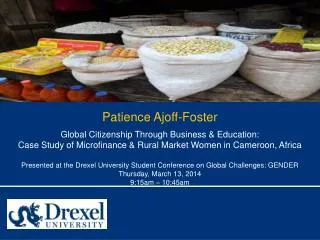
Patience Ajoff-Foster Global Citizenship Through Business & Education: Case Study of Microfinance & Rural Market Women in Cameroon, Africa Presented at the Drexel University Student Conference on Global Challenges: GENDER Thursday, March 13, 2014 9:15am – 10:45am
ABOUT CAMEROON – GEOGRAPHY CIA World Factbook
MORE COUNTRY INFORMATION… CIA World Factbook
What is the GCTBE Microfinance Project? • A research based project which seeks to transition rural market women from the informal to the formal market sector • Market Women • Formal and Informal Market Sector Cameroon Formal/Informal Sector in 2012 World Bank Report (2012)
The GCTBE PROGRAM AT A GLANCE • Phase II • Training sessions • Phase I • Participant Selection • Phase III • Grants/Loan awards • Funded recipients’ monitoring • Program assessment and evaluation • Selection of sophomore cohort
The Pilot/Case Study – Microfinance & Rural Market Women in Cameroon • Partnership with Bamenda University of Science and Technology and Bonazah Community Development of Africa • 2 students selected from the Faculty of Economics, Law & Management Sciences • Faculty Assignment • Selected 15 market women for the inaugural class
PILOT PROGRAM IMPLEMENTATION • Pre-training Survey • Women received assistance with completion of survey as needed • Six week customized business training • Based on results of survey • Entrepreneurship • Management • Business/marketing/financial plan • Financial statements/balance sheet • Bookkeeping – cash payment/cash receipt • Funding • Grants • Loans
Business capital Current business capital vs original amount borrowed
What would you like to gain from the training? • Learn how to manage my money • How to manage my workers • All things on marketing • Everything about business • Keep capital from other expenses • Keep money in financial institution • Business management, loan management, resource management (human and product) • To sell and manage my business well and the money • How to take care of livestock • Business expansion • Improve business situation
How do you see yourself in two years? • Growing in my business and able to educate my children • Increase in capital and longevity in business • Great improvement in business • Expanding greatly in business because of what I have learned • I will grow because this knowledge will not go in vain • By 2015, my business will/must grow because I always put back part of my capital into my business • I will improve my business from the money received • I will make sure I expand my business • Expand my business, increase my production to meet up with demands in my community
MONITORING & EVALUATION • Continue work with four women who are funded • One, three, and six month follow-up to monitor progress • Program evaluation to determine areas for improvement • Selection of next group of women
GCBTE PROGRAM OPPORTUNITIES • Transferability • Can be replicated in other parts of Sub-Saharan Africa • Partnerships can be extended to local and foreign institutions • Impact on Microfinance sector
ACKNOWLEDGEMENTS • Professor Emmanuel Akotia • EvadineTembeik • ImmanuelaLumChe • Jibril Ibrahim Ringnyu
More information Website: www.ruralmarketdevelopers.org Email: ajoffpat@alumni.upenn.edu