Download
1 / 41
420 likes | 531 Vues
Connective tissue (CT) is defined by a limited number of cells and abundant extracellular ground substance, lacking polarity. All connective tissues originate from embryonic mesenchyme and serve vital functions such as connection, support, protection, nutrition, defense, and repair. There are two classifications: CT proper (loose and dense connective tissues) and specialized forms (cartilage, bone, and blood). Key cell types include fibroblasts, macrophages, and adipocytes, each with distinct structures and functions. These components make CT essential for tissue integrity and physiological functions.

E N D
1. General features: 1) small number of cells and large amount of extracellular ground substance 2) no polarity 3) all of them originate from mesenchyme -embryonic CT 4) have functions of connection, supporting, protecting, nutrition, defence and repairing
mesenchyme ---mesenchymal cell: structure: • stellate in shaped with processes • a large nucleus, with clear nucleoles • slight basophilic cytoplasm function: a. undifferentiated cell b. multiple developmental potential→CT cell, SM and endothelial cell ---matrix
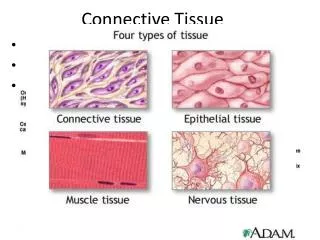
2.Classification (1) CT in narrow sense means connetive tissue proper which include: loose CT dense CT adipose T reticular tissue
(2) CT in wide sense includes : cartilage bone blood
3.Loose connective tissue (areolar tissue) • consists of cells, fiber and ground substance features: have more types of cells and less fibers
① fibroblast ---structure: LM: • large,flattened cell with processes- stellate in shaped • Large ovoid pale nucleus - contain more fine chromatin, with clear one or two nucleoli • Weakly basophilic cytoplasm
EM: • rich in RER, Golgi appatatus and free ribosome ---function: synthesize fibers and ground substance
fibrocyte: still state or inactive fibroblast ---structure: • spindle-shaped, small • N:small,dark stained • Acidophilic cytoplasma • EM: less organelles ---function: become into fibroblast for repairing
fibroblast fibroblast fibrocyte fibrocyte
②macrophage ---structure: LM: • Round, ovoid or irregular in shape • have short blunt processes: pseudopodium • Small and dark nucleus • Acidophilic cytoplasm
EM: rich in • a.Lysosome(溶酶体) • b.Phagosome: phagocytosis(吞饮作用) • pinosome(吞饮体): pinocytosis(胞饮作用) • c.Remnant • d.Microfilament and microtubule
---function: a. Chemotaxis: chemotactic factor b. phagocytosis: (1)Special phagocytosis: recognize bacterium, virus and foreign cell phagocytosis
(2)non specialphagocytosis: carbon particles, dust and dead cells
c.secretion: lysozyme(溶菌酶), complement and interleukin-I (IL-1)and interferon(INF) d.antigen presenting function
③plasma cell ---structure: LM: • round or ovoid • Nucleus with more spot-liked heterochromatin which located eccentrically • Basophilic cytoplasm
EM: rich in parallelly arranged RER, free ribosome and Golgi complex ---function: synthesize and secrete immunoglobulin, Ig-antibody
④mast cell ---structure: LM: • Round and large cell • Small dark-stained nucleus • Basophilic secreting granules
Basophilic secreting granules: • heparin: an anticoagulant • Histamine: cause cap. permeability↑, cap. leakage to form edema and contraction of SM • Eosinophil chemotactic factor (chemotactic factor: macrophage, leukocytes)
Cytoplasm contain: slow reaction substance ---function: to cause allergic reaction
⑤fat cell ---structure: • large, round or polygonal • flattened ovoid nucleus located on one side of cell • thin layer of cytoplasm • a large lipid droplet ---function: synthesize and store fat
⑥undifferentiated mesenchymal cell ---structure: similar to fibrocyte ---function: multidifferentiating potential
⑦leukocytes: neutrophil, acidophil and lymphocyte, ect. lymphocyte neutrophil acidophil
①collagenous fiber (white fiber) LM: • 1-20 um in diameter • Belt-liked wave and branch to form a network • Eosinophilic
EM: parallel-arranged fibrils Fibril: • 20-200nm in diameter • Have periodic cross striation at 64nm interval
② elastic fiber (yellow fiber) LM: • thinner and less, 0.2-1.0 um • Slight red (HE) branch and form a network EM: • core: elastin-low electron density • Peripheral: microfibril 10-12 nm, electron dense ↑ fibrillin(微纤维蛋白)
③reticular fiber LM: • thin and less,0.2-1.0 um in diameter • Branch to form network • Argyrophilic fiber (silver impregnation method)
EM: type III collagen 64nm cross striation ---distribution: reticular tissue connecting portion, e.g. reticular lamina
3) ground substance ---amorphous colloidal substance ---consists of proteoglycan, glycoprotein and tissue fluid
4.Dense connective tissue ---more fiber ---connection and supporting
1) regular DCT: • parallelly-arranged collagenous fibers • tendon cells: special fibroblast wing-liked processes ---distribution: tendons, ligament and cornea
2) irregular DCT: • Fiber arranged in bundles, running in different direction • Fibroblast • less ground substance ---distribution: dermis, sclera and capsule of some organs
5.adipose tissue ---LCT+fat cells ---white fat T: • single fat cell • distribution in subcutaneous tissue, mesenterium ---brown fat T: • fat cell contain many small lipid droplets, • rich in large mitochondria • centrally-located nucleus • rich in cap. • distribution: neonate
white fat T brown fat T
6.reticular tissue ---reticular cells: • stellate with processes-form network • round, ovoid and pale nucleus with 1-2 nucleoli • EM: rich in RER ---reticular fiber: connect to form network ---distribution: hemopoietic tissue and lymphatic tissue