Understanding Stoichiometry: Balancing Reactions and Calculating Product Mass
This overview of stoichiometry explores the essential steps in solving chemical reaction problems, highlighting the importance of reasoning backward as illustrated by Sherlock Holmes. It covers balancing chemical equations and calculating the masses of reactants and products based on mole ratios. Using the example of aluminum reacting with oxygen, we demonstrate how to identify reactants, write balanced equations, and calculate the yields of products like aluminum oxide. Understanding limiting reactants is also crucial in determining the maximum amount of product formed.

Understanding Stoichiometry: Balancing Reactions and Calculating Product Mass
E N D
Presentation Transcript
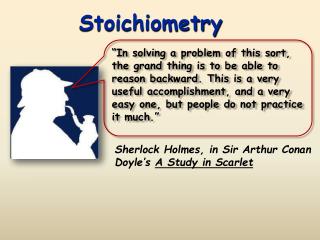
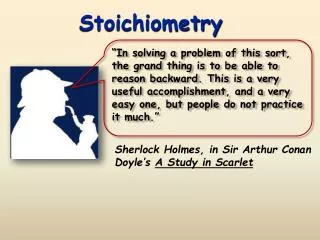
Stoichiometry “In solving a problem of this sort, the grand thing is to be able to reason backward. This is a very useful accomplishment, and a very easy one, but people do not practice it much.” Sherlock Holmes, in Sir Arthur Conan Doyle’s A Study in Scarlet
Review: Chemical Equations C2H5OH + 3O2® 2CO2 + 3H2O reactants products When the equation is balanced it has quantitative significance: Chemical change involves a reorganization of the atoms in one or more substances. 1 mole of ethanol reacts with 3 moles of oxygen to produce 2 moles of carbon dioxide and3 moles of water
Calculating Masses of Reactants and Products • Balance the equation. • Convert mass or volume to moles, if necessary. • Set up mole ratios. • Use mole ratios to calculate moles of desired substituent. • Convert moles to mass or volume, if necessary.
Working a Stoichiometry Problem 6.50 grams of aluminum reacts with an excess of oxygen. How many grams of aluminum oxide are formed. 1. Identify reactants and products and write the balanced equation. 4 Al + 3 O2 2 Al2O3 a. Every reaction needs a yield sign! b. What are the reactants? c. What are the products? d. What are the balanced coefficients?
Working a Stoichiometry Problem 6.50 grams of aluminum reacts with an excess of oxygen. How many grams of aluminum oxide are formed? 4 Al + 3O2 2Al2O3 6.50 x 2 x 101.96÷ 26.98 ÷ 4 = 12.3 g Al2O3 6.50 g Al 1 mol Al 2 mol Al2O3 101.96 g Al2O3 = ? g Al2O3 4 mol Al 1 mol Al2O3 26.98 g Al
Limiting Reactant The limiting reactant is the reactant that is consumed first, limiting the amounts of products formed.