Current State of Pediatric Continuous Renal Replacement Therapy: A National Survey Analysis
140 likes | 268 Vues
This national survey, conducted among pediatric centers offering Continuous Renal Replacement Therapy (CRRT), reviews current trends and practices. With 42 responding centers, findings showed a mean of 12.8 pediatric CRRT patients per year per center, with variations in therapy types and staffing structures. The survey highlights educational approaches, equipment used, and anticoagulation methods. Results indicate a need for standardization in training and management through national certification programs. This study aims to improve consistency and outcomes in pediatric CRRT practices.


Current State of Pediatric Continuous Renal Replacement Therapy: A National Survey Analysis
E N D
Presentation Transcript
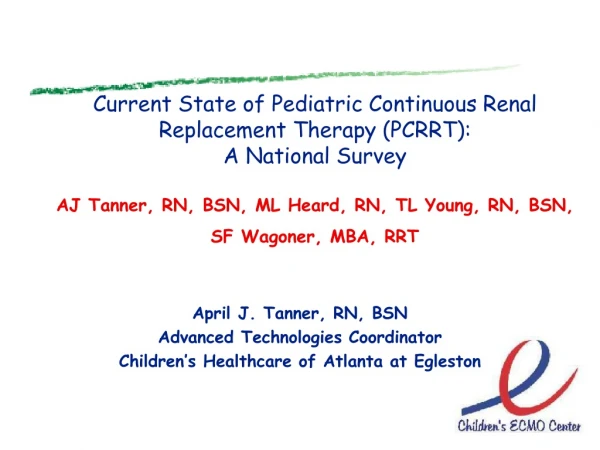
Current State of Pediatric Continuous Renal Replacement Therapy (PCRRT): A National Survey AJ Tanner, RN, BSN, ML Heard, RN, TL Young, RN, BSN, SF Wagoner, MBA, RRT April J. Tanner, RN, BSN Advanced Technologies Coordinator Children’s Healthcare of Atlanta at Egleston
A National Survey • An national review of current trends in CRRT • An 18 question survey sent to pediatric centers that offer CRRT • free-standing or based in adult facility • 42 centers responded
Therapy Types • 22 of 42 centers offer all available therapies • Mean PCRRT pts per year: 12.8 (1-60) • Median pts per year: 9 • 50% of centers have <10 patients per year • Average daily census of ICU’s: 13 • range of 5-27
Logistics and Coordination of System Set-up • 11 of 42 centers have no formal 24/7 coverage • In 93% of center’s RNs manage the pump • dialysis, ECMO, and physicians make up the other % • Charge structure • the dept.that sets up equipment receives revenue in majority of centers • 21 of 42 centers also have daily charges • varied response as to where revenue goes
Education • Wide variety of teaching methods • Didactic/hands on skills lab training occurs in 69% of initial training sessions • 12% require mentoring shifts • 17% offer informal training • 7% utilize bedside training methods
Education • Annual recertification - 43% • More frequent recertification occurs 26% • smaller volume programs • 19% of programs have no formal annual competency or recertification programs • Many centers education programs are under review
Equipment and Supplies • Solutions • Custom made - 36% • Normocarb - 31% • Remaining centers used a combination of normocarb and custom or prismanate • Med-comp is the catheter of choice in 45% of programs
Anticoagulation • 40% utilize citrate • 13 of 16 centers have converted from heparin to citrate within the last 2 years • Centers using both change depending on patient needs
What does all of this tell us? • Variable approaches to therapy, training, methods, equipment and supplies • National certification programs • help with consistency in training • PCRRT Registry • potential to help standardize management • develop protocols • review outcomes