Understanding Dozen Conversions: Eggs, Doughnuts, and Mass in Chemistry
This article discusses the concept of converting between different units using dozens, focusing on common items like eggs and doughnuts. It covers the basic conversions from dozens to individual particles and mass, explains the variations in mass for different substances, and provides practical examples of one-step and two-step problems. By the end, readers will understand how to navigate conversions between dozens, individual particles, and mass, and why these conversions matter in chemistry.

Understanding Dozen Conversions: Eggs, Doughnuts, and Mass in Chemistry
E N D
Presentation Transcript
Molar Conversions Or Everything is easier with doughnuts & dozens
A step sideways: Working in Dozens Dozen & particles conversion Dozen & mass conversion • 1 dozen eggs = 12 eggs • 1 dozen doughnuts = 12 doughnuts • Does it matter what the material is when you convert from dozen to particles? • 1 dozen eggs = 698 g • 1 doz doughnuts = 854 g • Why is the mass of a dozen different for each substance? • Are all eggs identical? Are doughnuts identical? Isotope analogy
Some sample 1-step problems Dozen to particle conversion Particle to dozen conversion • If you have 2.3 dozen eggs how many eggs do you have? • If you have 90 doughnuts how many dozen doughnuts do you have?
Some sample 1-step problems Dozen to mass conversion Mass to dozen conversion • If you have 2.3 dozen doughnuts how many grams of doughnuts do you have? • If you have 1750 g of eggs how many dozen eggs do you have?
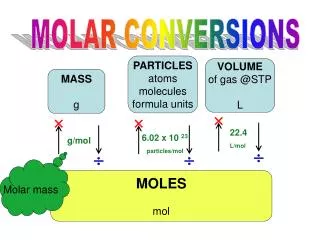
X 12 X mass of a dozen Dozen Particles Mass ÷ 12 ÷ mass of a dozen
Some sample 2-step problems Mass to particle conversion Particle to mass conversion • If you have 1300 g of doughnuts how many doughnuts do you have? • If you have 225 eggs how many grams of eggs do you have?
X 12 X mass of a dozen Dozen Particles Mass ÷ 12 ÷ mass of a dozen
Try these two problems on your own… • You have 140 g of doughnuts. How many dozen doughnuts do you have? • You have 19 eggs. How many grams of eggs do you have?
Chemistry Units? • So… If you easily work in dozens for doughnuts and eggs, are we going to work with dozens for atoms and molecules? Why or why not? • Should we measure the mass of an atom in grams? Why or why not?
Survey says… • You have 210 g of doughnuts. How many dozen doughnuts do you have? • Ans: You have 0.25 dozen doughnuts • This is a 1-step problem. If you got it wrong, go back and review that section of the video. • You have 19 eggs. How many grams of eggs do you have? • Ans: You have 1100g of eggs • This is a 2-step process. If you got it wrong, go back and review that section of the video.