Understanding TCP/IP Transport Protocols: Ranges, Services, and Mechanisms
This comprehensive guide covers the essential aspects of TCP/IP transport protocols. It discusses process-to-process communication, the significance of port numbers, encapsulation and decapsulation processes, and the differences between connection-oriented and connectionless services. Key transport protocols like TCP, UDP, SCTP, and DCCP are explored, along with their unique features, including multiplexing, flow control, and error detection. Additionally, the document clarifies the configuration of port number ranges and the concept of ephemeral ports for clients.

Understanding TCP/IP Transport Protocols: Ranges, Services, and Mechanisms
E N D
Presentation Transcript
Transport protocols Speaker : Sally Date:2012/07/26
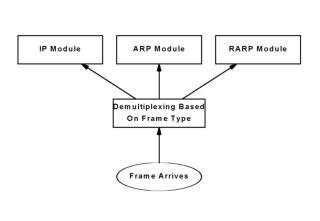
Protocol Stack (Open Systems Interconnection) The TCP/IP Guide : http://www.tcpipguide.com/free/t_TCPIPArchitectureandtheTCPIPModel-2.htm
Process to Process Communication Processes : Running application programs Network layer versus transport layer TCP/IP Protocol Suite (Behrouz A. Forouzan)
Addressing: Port numbers TCP/IP Protocol Suite (Behrouz A. Forouzan)
IP addresses versus Port numbers TCP/IP Protocol Suite (Behrouz A. Forouzan)
Socket address • Local Host (IP address) • Local Process (port number) • Remote Host • Remote Process TCP/IP Protocol Suite (Behrouz A. Forouzan)
Question: • The port numbers are divided into three ranges. Please explain these three ranges and which range is chosen as ephemeral port numbers for clients? • the word ephemeral means short lived. • Which port number is used by Nameserver? TCP/IP Protocol Suite (Behrouz A. Forouzan)
Encapsulation and Decapsulation TCP/IP Protocol Suite (Behrouz A. Forouzan)
Multiplexing and Demultiplexing (one to many) (many to one) TCP/IP Protocol Suite (Behrouz A. Forouzan)
Flow/Error/Congestion Control • Flow Control • To prevent the overflow of buffers in communicating end-points • Error Control • Error detection. (loss or corrupted data) • Congestion Control • To prevent the overflow of buffers in the routers TCP/IP Protocol Suite (Behrouz A. Forouzan)
Connectionless service TCP/IP Protocol Suite (Behrouz A. Forouzan)
Connection-oriented service TCP/IP Protocol Suite (Behrouz A. Forouzan)
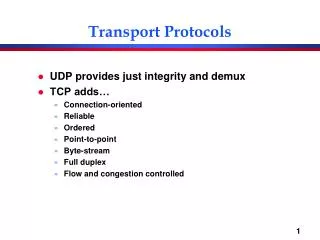
Transport protocols • UDP • User Datagram Protocol • TCP • Transmission Control Protocol • SCTP • Stream Control Transmission Protocol • DCCP • Datagram Congestion Control Protocol
Socket programming + Wireshark Question ? Yuan-Cheng Lai, “DCCP: Transport Protocol with Congestion Control and Unreliability”, IEEE Internet Computing, Vol 12, No 5, Sep/Oct 2008, pages 78 - 83.
SCTP: Multi-streaming and Multi-homing S. Fu and M. Atiquzzaman, “SCTP: state of the art in research, products, and technical challenges”, IEEE Communications Magazine, Volume 42, Issue 4, April 2004, Pages 64-76.
DCCP • DCCP • Combines unreliable transmission (meeting real time application needs) and various congestion controlmechanisms (ensuring fairness in the Internet) • Two basic functions: • Establish, maintain & teardown unreliable connections • Impose congestion control on unreliable connections NWEN402-Internet Engineering-New Transport-Protocols (Prof. Winston)