Transport Protocols
This document offers an overview of the transport protocols within the TCP/IP suite, focusing on TCP (Transmission Control Protocol) and UDP (User Datagram Protocol). The discussion highlights the end-to-end nature of transport layer protocols, the differences between reliable (TCP) and unreliable (UDP) communications, and their respective applications. While TCP is used for most Internet applications such as web browsing, email, and file transfer, UDP serves primarily in network management and multimedia contexts. Understanding these protocols is essential for optimizing network communication.

Transport Protocols
E N D
Presentation Transcript
Transport Protocols Relates to Lab 5. An overview of the transport protocols of the TCP/IP protocol suite. Also, a short discussion of UDP.
Orientation • We move one layer up and look at the transport layer.
Orientation • Transport layer protocols are end-to-end protocols • They are only implemented at the hosts
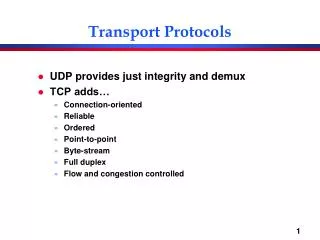
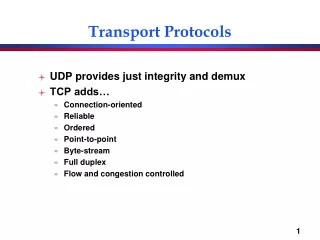
UDP - User Datagram Protocol datagram oriented unreliable, connectionless simple unicast and multicast useful only for few applications, e.g., multimedia applications used a lot for services network management (SNMP), routing (RIP), naming (DNS), etc. TCP - Transmission Control Protocol stream oriented reliable, connection-oriented complex only unicast used for most Internet applications: web (http), email (smtp), file transfer (ftp), terminal (telnet), etc. Transport Protocols in the Internet The Internet supports 2 transport protocols
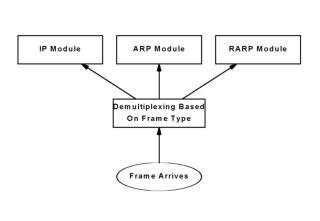
UDP - User Datagram Protocol • UDP supports unreliable transmissions of datagrams • UDP merely extends the host-to-to-host delivery service of IP datagram to an application-to-application service • The only thing that UDP adds is multiplexing and demultiplexing
UDP Format Port numbers identify sending and receiving applications (processes). Maximum port number is 216-1= 65,535 Message Length is at least 8 bytes (I.e., Data field can be empty) and at most 65,535 Checksum is for whole UDP segment and pseudo header of IP - I.e., some of the IP header fields -protocol number, source and dest. address and UDP length field (again).
Port Numbers • UDP (and TCP) use port numbers to identify applications • A globally unique address at the transport layer (for both UDP and TCP) is a tuple <IP address, port number> • There are 65,535 UDP ports per host.