Download
1 / 28
280 likes | 401 Vues
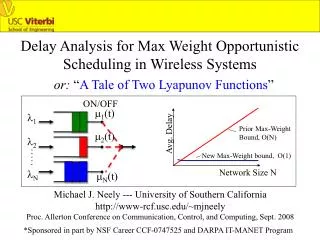
This study by Michael J. Neely from the University of Southern California examines delay optimality in opportunistic scheduling for multi-user wireless uplinks and downlinks. The system model involves N users, 1 server, and discrete time slots where packet arrivals and channel states (ON/OFF) are considered. The paper explores scheduling constraints, capacity regions, and delay performance in symmetric systems, drawing on prior research. Key insights into delay bounds and scheduling strategies highlight the significance of channel awareness in efficient resource allocation.

E N D
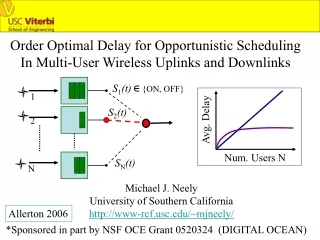
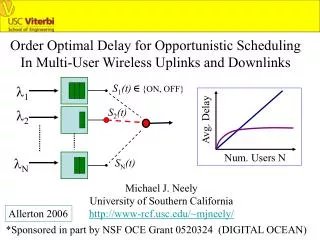
S1(t) {ON, OFF} Avg. Delay Order Optimal Delay for Opportunistic Scheduling In Multi-User Wireless Uplinks and Downlinks l1 S2(t) l2 Num. Users N lN SN(t) Michael J. Neely University of Southern California http://www-rcf.usc.edu/~mjneely/ Allerton 2006 *Sponsored in part by NSF OCE Grant 0520324 (DIGITAL OCEAN)
The System Model: N Users , 1 Server q1 Uplink l1 q2 l2 N 1 2 lN qN Downlink user 1 user N Discrete Time System: Timeslots t = {0, 1, 2, …} Qi(t) = Current Num. Packets in queue i Ai(t) = Arrivals to Queue i during slot t [ i.i.d over slots , E[Ai(t)] = li ] Si(t) = Current Channel State ({ON, OFF}) [ i.i.d. over slots, Pr[Si(t) = ON] = qi ] mi(t) = Packets Transmitted over link i on slot t
mi(t) {0,1} N mi(t) 1 i=1 The System Model: N Users , 1 Server q1 Uplink l1 q2 l2 N 1 2 lN qN Downlink user 1 user N Discrete Time System: Timeslots t = {0, 1, 2, …} mi(t) Ai(t) Qi(t) Qi(t+1) = max[Qi(t) - mi(t), 0] + Ai(t) Scheduling Constraints: Can serve at most one “ON” link per slot: mi(t)=0 if Si(t)=OFF , ,
q1 l1 q2 l2 lN qN l2 l1 q1 , l1 q2 l1 + l2 q1 + (1-q1)q2 l1 This model is investigated in [Tassiulas, Ephremides 93]: Results of [Tas, Eph 93]: 1) Capacity Region L 2) LCQ Algorithm (“Largest Connected Queue”) 3) Delay Optimality for Symmetric Systems Model is central to channel-aware (“opportunistic”) scheduling. The Capacity Region L: Set of all rate vectors (l1, .., lN) that can be stabilized. Example: (N=2) L is the set of all (l1, l2) such that:
q1 l1 q2 l2 lN qN iI iI (1-qi) 1 - li This model is investigated in [Tassiulas, Ephremides 93]: Results of [Tas, Eph 93]: 1) Capacity Region L 2) LCQ Algorithm (“Largest Connected Queue”) 3) Delay Optimality for Symmetric Systems Model is central to channel-aware (“opportunistic”) scheduling. The Capacity Region L: Set of all rate vectors (l1, .., lN) that can be stabilized. General Case for N: (l1, .., lN) L if and only if for each of the 2N-1 non-empty subsets I of {1, .., N}
An isolated set of delay-optimality results: q l q l l q For Symmetric Systems: -Largest Connected Queue (LCQ) [Tassiulas and Ephremides 93]: Proof uses stochastic coupling and exploits symmetry… -Rate Allocation in Gaussian Multiple Access Channels [Yeh 2001 , Yeh and Cohen 2003] -Multi-Server Systems: [Yeh 2001 , Ganti, Modiano, Tsitsiklis 2002]
An isolated set of delay-optimality results: q The actual delay that is achieved is unknown (even for these symmetric cases) O(N)? O( N )? O(1)? l q l l q For Symmetric Systems: -Largest Connected Queue (LCQ) [Tassiulas and Ephremides 93]: Proof uses stochastic coupling and exploits symmetry… -Rate Allocation in Gaussian Multiple Access Channels [Yeh 2001 , Yeh and Cohen 2003] -Multi-Server Systems: [Yeh 2001 , Ganti, Modiano, Tsitsiklis 2002]
An isolated set of delay-optimality results: q The actual delay that is achieved is unknown (even for these symmetric cases) O(N)? O( N )? O(1)? l q l l q For Heavy Traffic: r = fraction l is away from capacity region boundary Shakkottai, Srikant, Stolyar 2004 r 1 (Heavy Traffic) An exponential Scheduling Rule approaches delay optimality (r 1)
Related: Delay for N x N Switch Scheduling: 1 N 3 N 1 2 -[Leonardi, Mellia, Neri, Marsan 2001]: O(N/(1-r)) Delay bound (MWM Sched.) -[Neely, Modiano 2004]: O(log(N)/(1-r)2) Delay bound (Frame Based Sched.)
Related: Delay for N x N Switch Scheduling: 1 N 3 N 1 2 Some Interesting Queue Grouping Approaches (mainly to reduce complexity): -Mekkittikul, McKeown (1998) -Shah (2003) -Wu, Srikant (wireless, 2006)
Related: Delay for N x N Switch Scheduling: 1 N 3 N 1 2 Some Interesting Queue Grouping Approaches (mainly to reduce complexity): -Mekkittikul, McKeown (1998) -Shah (2003) -Wu, Srikant (wireless, 2006) = + -Leonardi et al. (2001)
Related: Delay for N x N Switch Scheduling: 1 N 3 N 1 2 Some Interesting Queue Grouping Approaches (mainly to reduce complexity): -Mekkittikul, McKeown (1998) -Shah (2003) -Wu, Srikant (wireless, 2006) O(1) Delay when r < 1/2 (half loaded) = + -Leonardi et al. (2001)
N O( ) 1 O( ) (1-r) (1-r) What is the optimal delay (as a function of N) for the N user wireless problem with varying channels? q l q l l q Time Varying Channels make analysis more complex, cannot use same approaches as switch problems… Previous Upper and Lower Bounds: (N users) E[Delay] “Single-Queue Bound” [Neely, Modiano, Rohrs 03]
N 2rN(1-r) What is the optimal delay (as a function of N) for the N user wireless problem with varying channels? q l rN = 1-(1-q)N q l (max possible output rate) l q Our Results: (part 1) If scheduling doesn’t consider queue backlog (such as stationary randomized scheduling) then: E[Delay] is at least linear in N 2) Uniform Poisson Traffic: E[Delay] >
What is the optimal delay (as a function of N) for the N user wireless problem with varying channels? q l rN = 1-(1-q)N q l (max possible output rate) l q Our Results: (part 2) For any r such that r < 1 O( ) log(1/(1-r)) Independent of N Av. Delay (1-r) Holds for Symmetric Systems and a large class of Asymmetric ones
What is the optimal delay (as a function of N) for the N user wireless problem with varying channels? q l rN = 1-(1-q)N q l (max possible output rate) l q Our Results: (part 2) For any r such that r < 1 O( ) log(1/(1-r)) Independent of N Av. Delay (1-r) We use a form of queue grouping together with Lyapunov drift And statistical multiplexing
Intuition about Queue Grouping: N user System, Uniform Poisson inputs: q l rN = 1-(1-q)N q l (max possible output rate) l q Compare to a single-queue system with Pr[ON] = q l (GI/GI/1 queue) Pr[serve]=q l l Can show that any work conserving scheduling policy in multi- queue system yields delay that is stochastically smaller than single- queue system. Leads An easy upper bound on delay…
1 - ltot/2 q - ltot Intuition about Queue Grouping: N user System, Uniform Poisson inputs: q l rN = 1-(1-q)N q l (max possible output rate) l q Compare to a single-queue system with Pr[ON] = q l (GI/GI/1 queue) Pr[serve]=q l Poisson Bernoulli l Single Queue Upper Bound on Avg. Delay: Only works for ltot < q (i.e., r < g where g = q/rN) O( ) 1 = E[Delay] = (1-r/g)
Queue Grouping Approach: Form K Groups: {G1, G2, …, GK} i Gk l1 Qsum, k(t) = Qi(t) l2 G1 lM1 G2 lM1+1 GK lN
i Gk i Gk Qsum, k(t) = Qi(t) G1 G2 lsum, k = li GK { 1 , if group Gk has at least one non-empty connected queue. 0 , else Define: 1k(t) = The Largest Connected Group (LCG) Algorithm: Every slot t, observe the queue backlogs and channel states, and select the group k {1, …, K} that maximizes 1k(t)Qsum, k(t). Then serve any non-empty connected queue in that group (breaking ties arbitrarily).
Actual N-queue System Comparison K-queue System lsum, k= li qmin, k= min {qi} i Gk i Gk q1 1 qmin, 1 lsum, 1 q2 G1 lsum, 2 2 qmin, 2 G2 lsum, N K qmin, K GK qN Define: LK = Capacity region of the K-queue System Theorem: If there is an e > 0 such that: (lsum, 1 + e, lsum, 2 + e, . . . , lsum, K + e) LK Then LCG stabilizes the system and yields average delay:
Actual N-queue System Comparison K-queue System lsum, k= li qmin, k= min {qi} i Gk i Gk q1 1 qmin, 1 lsum, 1 q2 G1 lsum, 2 2 qmin, 2 G2 lsum, N K qmin, K GK qN Define: LK = Capacity region of the K-queue System Theorem: If there is an e > 0 such that: (lsum, 1 + e, lsum, 2 + e, . . . , lsum, K + e) LK If arrivals are independent and Poisson, then we have:
Theorem: If there is an e > 0 such that: (lsum, 1 + e, lsum, 2 + e, . . . , lsum, K + e) LK If arrivals are independent and Poisson, then we have: Proof Concept: Use the following Lyapunov function: LCG comes within additive constant of minimizing: (Lyapunov drift) 2) (tricky part) Prove there exists another algorithm that yields: (h() linear)
l l Q1(t) QN-1(t) l l Q2(t) QN(t) Application to Symmetric Systems: rN = 1-(1-q)N q (max possible output rate) q q ltot = rrN q For any loading r such that 0 < r < 1: For simplicity assume N = MK (K groups of equal size M) log(2/(1-r)) Choose K = log(1/(1-q)) Then e = rN(1-r)/(2K) , … Plug this into the theorem…
l l Q1(t) QN-1(t) l l Q2(t) QN(t) Application to Symmetric Systems: rN = 1-(1-q)N q (max possible output rate) q q ltot = rrN q For any loading r such that 0 < r < 1: For simplicity assume N = MK (K groups of equal size M) log(2/(1-r)) Choose K = log(1/(1-q)) 2K O( ) log(1/(1-r)) = Then LCG => E[W] rN(1-r) (1-r)
lN-1 QN-1(t) lN QN(t) Application to Asymmetric Systems: N (1-qi) rmax = 1 - q1 l1 Q1(t) i=1 q2 l1 Q2(t) (max possible output rate) ltot = rrmax qN-1 qN ltot = l1 + … + lN Form variable length groups by iteratively packing individual streams until total rate of the group exceeds ltot/N. Then: lsum, k < ltot/N + lmax for all groups k
lN-1 QN-1(t) > lN QN(t) Application to Asymmetric Systems: N (1-qi) rmax = 1 - q1 l1 Q1(t) i=1 q2 l1 Q2(t) (max possible output rate) ltot = rrmax qN-1 qN For any loading r such that 0 < r < 1: log(2/(1-r)) Choose K = Assume lmax < (1-r)rmax/(3K) log(1/(1-qmin)) O( ) log(1/(1-r)) For any N K, LCG => E[W] (1-r)
Conclusions: Order-Optimal Delay for Opportunistic Scheduling in a Multi-User System (N users) -Backlog-unaware scheduling: Delay grows at least linear with N -Backlog-aware scheduling: It is possible to achieve O(1) delay (independent of N) -The first explicit bound for optimal delay in this setting -Queue Grouping is a useful tool for analysis and design