Understanding Rhetorical Devices and Tone in Literature
80 likes | 216 Vues
In this lesson, we will explore J.D. Salinger's use of rhetorical devices in the quote, “It isn't very serious. I have this tiny little tumor on the brain.” We will analyze the speaker's voice, message, and the purpose behind these devices to understand the conveyed tone. Today's agenda also includes finishing the film, discussing mystery questions pertaining to *The Crucible*, developing theme statements with supporting quotes, reviewing the Miller article using SOAPSTone, and reflecting on the recent essay "On Want of Money," focusing on strengths and areas for improvement in our writing.


Understanding Rhetorical Devices and Tone in Literature
E N D
Presentation Transcript
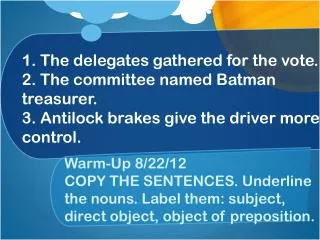
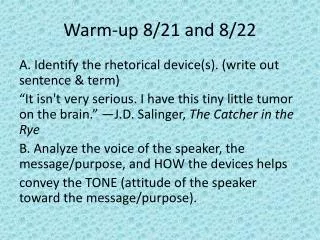
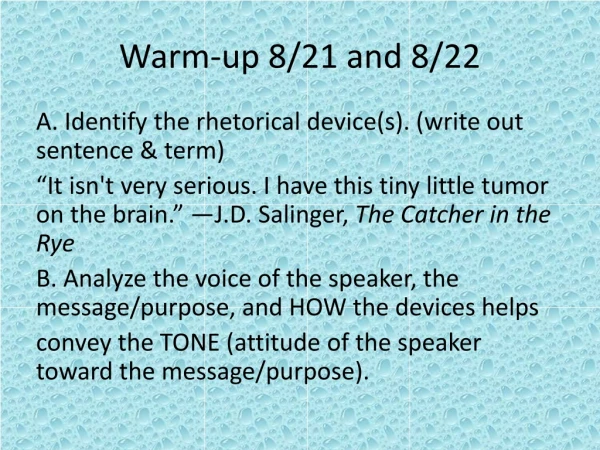
Warm-up 8/21 and 8/22 A. Identify the rhetorical device(s). (write out sentence & term) “It isn't very serious. I have this tiny little tumor on the brain.” —J.D. Salinger, The Catcher in the Rye B. Analyze the voice of the speaker, the message/purpose, and HOW the devices helps convey the TONE (attitude of the speaker toward the message/purpose).
Today’s agenda • Finish film • Mystery questions • Theme statements • Miller article- SOAPSTone and rhetorical précis • “On Want of Money” essay review and reflection
Mystery Questions Each group will receive an envelope with a question about The Crucible on it. Write the question and your well-developed answer on a whiteboard and present to the class.
THEME STATEMENTS You will receive a subject- you must take this subject and create a theme statement for the subject. You must support your theme statement with three quotes from the play.
Miller article • SOAPSTone (group) & rhetorical précis (individual) • Précis will be your first “real” writing grade • Score will be out of 10 points. Two points will be awarded for each complete, accurate sentence; two points overall for impression and depth.
“On Want of Money” • Reflection: Look at rubric and your score. Why do you think you received this score? • What RIP words did you use? List them. • Make notes of any comments that indicate a weakness you can improve upon.
Essay Weaknesses • Most prevalent mistake: misreading the word “want” to mean desire, want, or need. “Want” as used by Hazlitt in this time period means “lack of” or “without.” • Discussing how the rhetorical strategies affect the reader/audience rather than how they develop his position on money. • Speaking for Hazlitt or for the reader/audience. • Using first and second person • Organization (conclusions) • Discussing ONLY appeals
Essay Strengths • Much more analysis this time! • Identifying rhetorical strategies or devices, although there is still some confusion about the difference between the two. • Stronger introductions • Using what you learned from Thank You for Arguing. However, decorum applies more to appearance and behavior, rather than written arguments.