Financial statements
200 likes | 323 Vues
Financial statements are vital summaries of economic activity tailored to various user interests. Key components include the Balance Sheet, net working capital, liquidity, and the comparison between market and book values. An essential part is cash flow analysis, which measures the inflow and outflow of cash, crucial for capital budgeting. This guide also covers Corporate Tax considerations including marginal vs. average tax rates and Capital Cost Allowance (CCA) calculations for depreciation on assets, illustrated with examples for better understanding.


Financial statements
E N D
Presentation Transcript
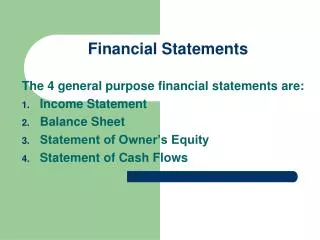
Financial statements Financial statements are general summaries of economic activity because user groups have diverse interests.
Some important issues • Net working capital (NWC) • Liquidity • Debt versus equity • Market value versus book value
Cash flow from assets The difference between the number of dollars that come in and the number that goes out. Crucial for capital budgeting analysis. Note that there is a standard accounting statement called the statement of cash flows, but it is different from what is nte necessary ingredient for financial analysis.
Example 1: Firm “Fantastic copy” bought a photo-copier for $22,000 (asset class 8, 20%), calculate the CCA over the years.
Depreciation on $22,000 Photocopier (CCA Class 8) Year UCC t CCA UCC t+1 1 11,000 2,200 $8,800 2 19,800 3,960 15,840 3 15,840 3,168 12,672 4 12,672 2,534 10,138 5 10,138 2,028 8,110 6 8,110 1,622 6,488
Example 2: A proposed cost saving device has an installed cost of 59,400. It is class 43 (30%) for CCA purposes. It will actually function for five years at which time it will have no value. Calculate UCC at the end of five years.
Question 2.30 Mississauga Manufacturing Ltd. Just invested in some new processing machinery to take advantage of more favorable CCA rates in a new federal budget. The machinery qualifies for 25% CCA rate and has an installed cost of $500,000. Calculate CCA and UCC for the first five years.