Exploring E-Business Models: A Comprehensive Overview of Digital Market Strategies
This article delves into various e-business models, focusing on how they bridge buyers and sellers in the digital marketplace. From traditional brokerage and merchant strategies to innovative approaches like auction brokers and affiliate marketing, we analyze the unique advantages each model offers. Learn how these models, including community-driven, subscription-based, and utility-oriented frameworks, shape the online commerce landscape. Discover insights into the roles of infomediaries and advertising in enhancing consumer experiences and generating value in e-commerce.

Exploring E-Business Models: A Comprehensive Overview of Digital Market Strategies
E N D
Presentation Transcript
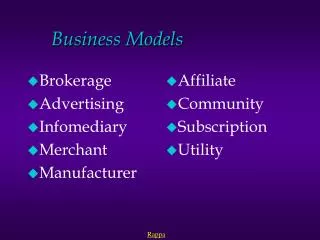
Brokerage Advertising Infomediary Merchant Manufacturer Affiliate Community Subscription Utility Business Models Rappa
Brokerage • Bringing together buyers and sellers • Fulfillment (e.g., Etrade) • Market Exchange (charge seller a fee; e.g., Metalsite) • Business Trading Community (vertical web community) • Buyer aggregator (buying group; Mobshop) • Distibutor (multi-vendor catalog; NECX) • Virtual Mall (hosts merchants via portal; Yahoo! Stores) • Metamediary (VM+processing+protection; zShops) • Auction Broker (conducts auctions for sellers; eBay) • Reverse auction (broker can earn spread; Priceline) • Classifieds (price may or may not be specified) • Search Agent (seeks goods/prices; MySimon) • Bounty Broker (reward for finding items; BountyQuest)
Advertising • Extension of traditional broadcasting model • Generalized Portal (high-volume; Yahoo!) • Personalized Portal (customized; My.Yahoo!) • Specialized Portal (vortal, targeted) • Attention/Incentive Marketing (pay for viewing; CyberGold, IWon) • Free Model (hosting, access, greeting cards; BlueMountain)
Infomediary • Collect and sell information about consumers • Recommender System (users exchange information about products/services; Deja.com; ePinions) • Registration Model (Content site, free to viewers, registration required; NYTimes.com)
Merchant Model • Classic wholesalers & retailers (auction or fixed price) • Virtual Merchant (Amazon; OnSale) • Catalog Merchant (Mail order migrated to the web; Levenger) • Click and Mortar (traditional + Web; Gap, Lands End; B&N) • Bit Vendor (Strictly digital, most often downloaded only; Eyewire)
The Others • Manufacturing Model: Eliminating an intermediary (Flowerbud, Dell) • Affiliate Model: Distributed sites provide click-through; (Amazon; BeFree) • Community Model: Users contribute content, funding, or knowledge on demand; newsgroups (fee version: Guru) • Subscription Model: Pay access; high value is essential (because 46% won’t pay) • Utility Model: Metered usage; pay as you go (Fatbrain)
Why do any E-Business? Meta Group study (Infoworld; 3-27-2000, p.24)
The Landscape: Business Models Economist, Feb 26, 2000
The Models • B to C: Generates transactions from consumers. • B to B: Interbusiness transactions. • B to B to C: Integration of activities from the supply chain to the consumer. Infoworld, 4-3-2000, p. 111 (M. Vizard)
Creative Cash Flow Models • Amazon.com has a unique advantage… • Shared by others?
Creative Approach: Business Method Patents! • Amazon: One-Click shopping • Amazon: Affiliates program • Open Market: shopping carts • Open Market: secure credit card trans. • Priceline.com: name-your-own-price auction • Sightsound.com: selling digital content for download (asking for 1% royalty) Actual Patents Owned (Infoworld, 3-6-2000, p. 30)
Amazon’s Patent • July 1998: Federal Appeals Judge rules that business processes can be patented. • October 1999: Amazon sues Barnes and Noble for one-click orders. • December: Judge agrees with Amazon, forcing B&N to add a step to its checkout process. • March 2000: Patent Office announces plans for tighter oversight of e-commerce patents. • Feb 2001: Judge allows Barnes & Noble to return to one-click ordering! Case still in lower court PC Week: 4-17-2000, pg. 80, Wall St. Journal Feb 2001