Download
1 / 13
140 likes | 281 Vues
This analysis delves into the dynamics of colonialism, particularly focused on the late 19th-century Scramble for Africa. It explores the motivations behind European imperialism, including national prestige and economic gain. The transition from slavery to exploitation through colonial trade is discussed, alongside the emergence of post-colonial literature and theory, highlighting significant theorists like Edward Said and Gayatri Spivak. Post-colonial works reflect the struggles of colonized peoples and challenge imperial narratives, emphasizing issues of identity and cultural hybridity.

E N D
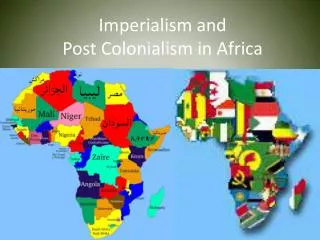
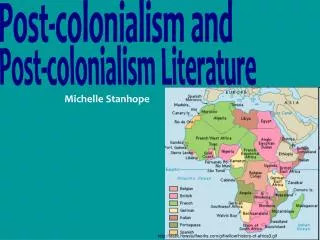
Scramble for Africa • Slave trade ended 1805, replaced by other trade • Late 1880s, European countries suddenly wanted colonies in Africa: • To build national prestige • To gain raw materials for factories • To gain markets for manufactured goods • To gain mineral wealth and prevent other European countries from acquiring such wealth • Europeans cooperated among themselves and divided Africa up
Scramble for Africa • Able to colonize late 19th century because: • Better medicines • Better guns
Postcolonial Literary Theory • Postcolonial Literature – body of literature written by authors with roots in countries once occupied by European nations • Postcolonial Theory – intellectual inquiry exploring and interrogating the situation of colonized people during and after colonization.
Characteristics of Postcolonialism • Anti-imperialist in character • Post (prefix) implies opposition and chronological sequence • Denotes period after colony has become independent • Connotes political and moral attitudes opposing colonization
Cultural Roots of Postcolonial Literature • South Asia • Africa • The Carribbean • Australia • New Zealand • Canada • Ireland
Postcolonial Theory • Raises and explores historical, cultural, political, and moral issues surrounding the establishment and disintegration of colonies and the empires they fueled.
Leading Postcolonial Theorists • Edward Said (politically active scholar of Palestinian descent teaching in the U.S.) • GayatriChakravortySpivak (Indianliterary critic, theorist teaches at Columbia University) • Homi K. Bhabha (Indian Professor of English and American Literature and Language, and the Director of the Humanities Center, at Harvard University)
Causes and Effects • Stereotypes of dominated culture contributes to establishment and domination through colonization • Gender and Class complicate understanding of impact of colonization • Silencing of women • Subjugation of “lower classes”
Terms • Agency – the ability to choose and speak independently • Hybridity – how colonized peoples coopted and transformed various elements of the colonizing culture adapting it into their new (hybrid) culture • Diaspora – the dispersion of peoples from their homelands
Leading Postcolonial Writers • Edward Ricardo Braithwaite (Guyana) To Sir with Love • Chinua Achebe (Nigeria) Things Fall Apart • Aime Cesaire (the Caribbean) Poet and Playwright • Frantz Fanon (the Caribbean and North Africa) Black Skin, White Masks
Concluding Thought… How is Things Fall Apart a post-colonial text?