Telescopes
Telescopes. Telescopes. Act as “electromagnetic radiation catchers” Capture as much as possible Focus Magnifies images Telescopes that “catch” visible light are called optical telescopes. (4). Telescope Terms. magnification (power) – how strong the telescope is.

Telescopes
E N D
Presentation Transcript
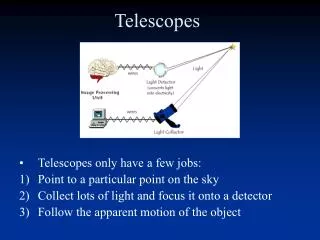
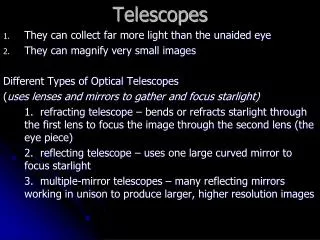
Telescopes • Act as “electromagnetic radiation catchers” • Capture as much as possible • Focus • Magnifies images Telescopes that “catch” visible light are called optical telescopes. (4)
Telescope Terms • magnification (power) – how strong the telescope is. • resolution - how close two objects can be and yet still be detected as separate objects. • aperture – diameter of the lens or mirror
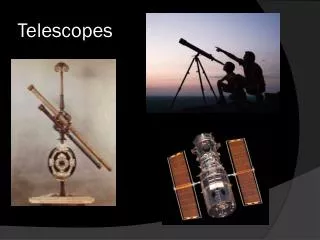
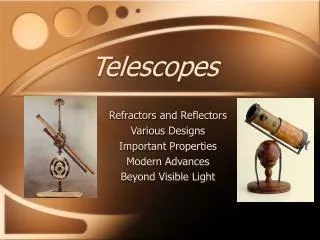
Refractor Telescopes (5) • Hans Lippershey of Middleburg, Holland, gets credit for inventing the refractor in 1608, and the military used the instrument first. Galileo (1609) is the first to use it for astronomy. • The objective lens gathers the light, and bends or refracts it to a focus near the back of the tube. The eyepiece lens brings the image to your eye, and magnifies the image. (5) • Refractors have good resolution, high enough to see details in planets and stars. • It is difficult to make large objective lenses (greater than 4 inches or 10 centimeters) for refractors. • Refractors are relatively expensive
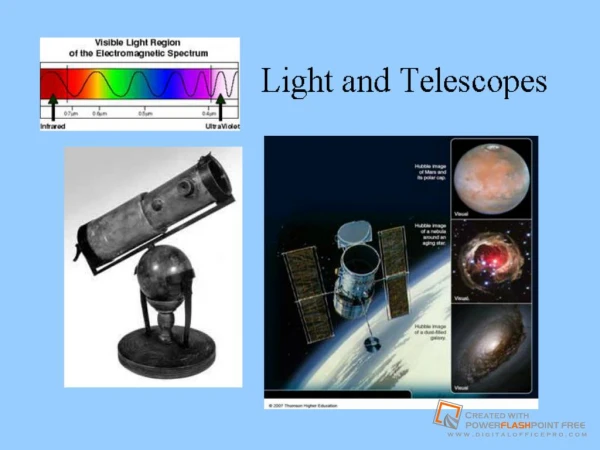
Reflector Telescopes(5) • Isaac Newton developed the reflector about 1680. • Newton used a curved, metal mirror to collect the light and reflect it to a focus. (5) • Because the mirror reflected light back into the tube, he had to use a small, flat mirror in the focal path of the first mirror to deflect the image out through the side of the tube, to the eyepiece; otherwise, his head would get in the way of incoming light.
Radio Telescopes (4) • Karl Jansky inadvertently discovered galactic emissions of radio waves in 1933 • Like optical telescopes, radio telescopes have reflectors and receivers • Radio telescopes collect radio waves and send them to a receiver (4) • Most radio telescopes need to be large in order to accommodate radio's longer wavelengths and lower energies • Can “see” day or night
Problems with Optical Astronomy (6) • Optical astronomers can only observe on clear, cloudless nights.(6) • Also, optical astronomers can only work after dark, when stars are visible.(6) • Radio wave data can be collected at almost any time, day or night.
Hubble Telescope • Hubble orbits 600 kilometers (375 miles) above Earth, working around the clock to unlock the secrets of the Universe. It uses excellent pointing precision, powerful optics, and state-of-the-art instruments to provide stunning views of the Universe that cannot be made using ground-based telescopes or other satellites.
The Very Large Telescope (VLT) • Cerro Paranal, Chile • Uses 4 separate large telescopes as well as several other small telescopes to create 1 large telescope. • The large telescope mirrors are 8 meters across.
Arecibo (Puerto Rico) The main reflector is 1000 feet in diameter It can see 1/3 of the sky at a time
The Very Large Array (VLA)New Mexico The VLA is equivalent to a dish 22 miles across
The Spectroscope (8) • The bands of colors that are produced when passed through a prism is called the visible spectrum. • Astronomers use the bands of colors from distant stars to learn more about those stars. • Spectroscope: tool used to separate starlight into its colors (8) • Composed of a prism that separates the light and then the spectrum of colors is viewed with a tiny viewing telescope (8)
Why a Spectroscope? (8) • The spectra viewed from this tool allows astronomers to determine which chemical elements are present in the star’s outer layers.(8) • Indicates temperature, pressure, magnetic field, and condition of gases in the stars.(8) • Allows astronomers to learn if the distance between Earth and the star is increasing or decreasing.(8) • One of the most useful tools that astronomers have for learning about the universe.
Other Eyes • X-Ray • Infrared • Gamma Ray
The Milky Way Galaxy • Radio • Infrared • Visual • X-Ray • Gamma Ray