Taylor Polynomial Approximations
100 likes | 213 Vues
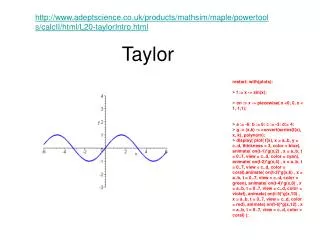
This demonstration illustrates the best Taylor polynomial approximations of a function at x=0, including first-order (linear), second-order (quadratic), third-order (cubic), sixth-order, eighth-order, tenth-order, and one-hundredth-order approximations. Each polynomial, from P1(x) to P100(x), is designed to match the function's value and derivatives at x=0. The graphical representation showcases how closely these polynomials approximate the function over the interval [-3, 3] and explores the behavior within a wider range of [-6, 6].


Taylor Polynomial Approximations
E N D
Presentation Transcript
Taylor Polynomial Approximations A graphical demonstration
Approximating • Best first order (linear) approximation at x=0. • OZ calls this straight line function P1(x). • Note: f(0)=P1(0) and f’(0)=P’1(0).
Approximating • Best second order (quadratic) approximation at x=0. • OZ calls this quadratic function P2(x). • Note: f(0)=P2(0), f’(0)=P’2(0), and f’’(0)=P’’2(0).
Approximating • Best third order (cubic) approximation at x=0. • OZ calls this cubic function P3(x). • Note: f(0)=P3(0), f’(0)=P’3(0), f’’(0)=P’’3(0), and f’’’(0)=P’’’3(0), .
Approximating • Best sixth order approximation at x=0. • OZ calls this function P6(x). • P6 “matches” the value of f and its first 6 derivatives at x=0.
Approximating • Best eighth order approximation at x=0. • OZ calls this function P8(x). • P8 “matches” the value of f and its first 8 derivatives at x=0.
Approximating • Best tenth order approximation at x=0. • This is P10(x).
Approximating • Best hundedth order approximation at x=0. • This is P100(x). • Notice that we can’t see any difference between f and P100 on [-3,3].
Approximating • What happens on [-6,6]?
Approximating ---Different “centers” Third order approximation at x=0 Third order approximation at x= -1