Understanding Hypothesis Testing Through Coin Tosses and Card Drawings
Hypothesis testing involves calculating the probability of outcomes based on specific assumptions. For instance, when tossing a fair coin, we assume the probability of landing heads is ½, leading to various outcomes as we increase the number of tosses. Similarly, with a standard deck of cards, the probability of correctly naming a randomly drawn card is 1/52 under the assumption that each card is equally likely. If the observed probability of outcomes is too low compared to our hypothesis, we reject it, reinforcing the importance of statistical analysis in validating assumptions.

Understanding Hypothesis Testing Through Coin Tosses and Card Drawings
E N D
Presentation Transcript
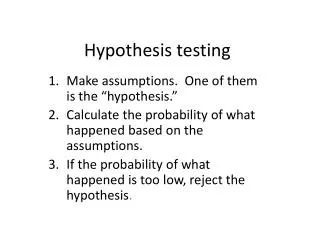
Hypothesis testing Make assumptions. One of them is the “hypothesis.” Calculate the probability of what happened based on the assumptions. If the probability of what happened is too low, reject the hypothesis.
Coin • Assumption: The probability of heads is ½. • One toss possibilities: • The assumption implies that each possibility is equally likely.
Coin • Assumption: The probability of heads is ½. • Two toss possibilities: • The assumption implies that each possibility is equally likely.
Five toss possibilities (each hypothesized to have probability of 1/32 = .03125):
If hypothesis is true that heads and tails are equally likely heads
Six tosses possibilities, each hypothesized to have a probability of 1/64 = .015625:
The probability of correctly naming a card drawn at random is
The probability of correctly naming a card drawn at random is 1/52 • … if you hypothesize that every card is equally likely to be drawn