
The Impact of Antibiotics on Bacteria: Historical Insights and Current Challenges
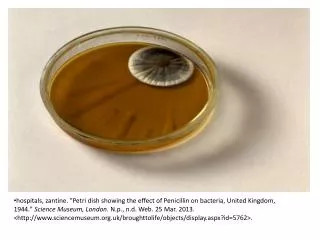
This article explores the historical significance of Penicillin on bacterial infections, first illustrated in the famous petri dish experiments from 1944 in the UK. It highlights the ongoing battle against antibiotic resistance, particularly focusing on Methicillin-Resistant Staphylococcus aureus (MRSA). With increasing antibiotic sales in meat and poultry production raising concerns, we will examine the implications for human health and the urgent need for effective strategies in combating the rise of superbugs.

The Impact of Antibiotics on Bacteria: Historical Insights and Current Challenges
E N D
Presentation Transcript
hospitals, zantine. "Petri dish showing the effect of Penicillin on bacteria, United Kingdom, 1944." Science Museum, London. N.p., n.d. Web. 25 Mar. 2013. <http://www.sciencemuseum.org.uk/broughttolife/objects/display.aspx?id=5762>.
"Antibiotic-resistance: fighting the superbug." Pharmaceutical Research News & Drug Development Pipeline Information. Informa Healthcare/Mortimer House, n.d. Web. 25 Mar. 2013. <http://www.pharmaprojects.com/therapy_analysis/Antibiotic-resistance-0708.html>.
Payne, Oran. "Angles: Combating Methicillin-Resistant Angles: Combating Methicillin-Resistant Staphlococcus aureus by Oran PayneStaphylococcus aureus."MIT - Massachusetts Institute of Technology. N.p., n.d. Web. 25 Mar. 2013. <http://web.mit.edu/angles/Oran_Payne.htm>.
Topic. "Record-High Antibiotic Sales for Meat and Poultry Production." The Pew Charitable Trusts. Pew Campaign on Human Health and Industrial Farming, 6 Feb. 2013. Web. 25 Mar. 2013. <http://www.pewhealth.org/reports-analysis/data-visualizations/record-high-antibiotic-sales-for-meat-and-poultry-production-85899449165>.