Management of Pseudoaneurysm Following SFA Stenting in a Patient with Vascular Disease
A 69-year-old female with a history of hypertension, hyperlipidemia, hypothyroidism, and peripheral vascular disease develops left lower extremity claudication and is found to have a pseudoaneurysm in the left mid-thigh. Previous treatments included bilateral SFA stenting and unsuccessful thrombolysis. Imaging reveals a significant increase in claudication severity and elevated blood flow velocities at the site. Surgical intervention involves resection of the pseudoaneurysm and revision of the femoral to popliteal artery bypass using an interposition vein graft. Postoperative monitoring for complications is critical.

Management of Pseudoaneurysm Following SFA Stenting in a Patient with Vascular Disease
E N D
Presentation Transcript
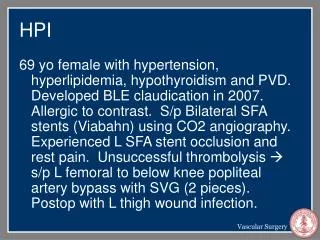
HPI 69 yo female with hypertension, hyperlipidemia, hypothyroidism and PVD. Developed BLE claudication in 2007. Allergic to contrast. S/p Bilateral SFA stents (Viabahn) using CO2 angiography. Experienced L SFA stent occlusion and rest pain. Unsuccessful thrombolysis s/p L femoral to below knee popliteal artery bypass with SVG (2 pieces). Postop with L thigh wound infection.
HPI (cont) Began to have recurrent LLE claudication. Evaluated by duplex and found to have a 2.3x2.3 cm pseudoaneurysm in the mid thigh. MRA confirmed a 2.9 cm pseudoaneurysm in the left mid thigh. Duplex (5/08): elevated velocity of 517 cm/s in the area of the venovenous anastamosis and a narrowed vein graft segment distal to pseudoaneurysm. ABI 0.56 (from 0.94 in 4/08)
Operation: • Resection of SVG bypass pseudoaneurysm • Revision Femoral to Popliteal artery bypass with interposition vein graft Findings: 4x2 cm pseudoaneurysm