Advanced Coating Techniques for High-Performance Transistors Using Flexible TFT and Graphene Materials
This experimental study explores the use of flexible TFT and graphene materials for advanced transistor coating techniques. From fixation methods to surface treatments, the research investigates various approaches to enhance transistor performance and reliability. Key findings include the impact of different gate dielectric coatings on leakage current and the challenges of graphene transfer and electrode contact. Future work includes hydrophilic surface treatments and H2 annealing to optimize performance. Additionally, the potential application of topological insulators for quantum computing is discussed.

Advanced Coating Techniques for High-Performance Transistors Using Flexible TFT and Graphene Materials
E N D
Presentation Transcript
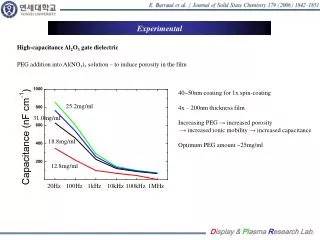
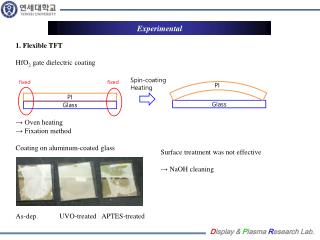
Experimental 1. Flexible TFT HfO2 gate dielectric coating → Oven heating → Fixation method Coating on aluminum-coated glass As-dep. UVO-treated APTES-treated Spin-coating Heating fixed fixed PI PI Glass Glass Surface treatment was not effective → NaOH cleaning
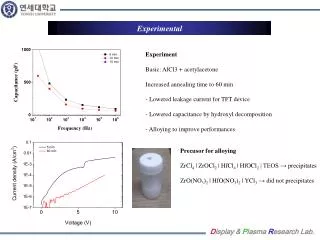
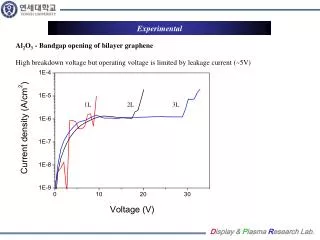
Experimental 2. High-k & Graphene transistor Al2O3 - Significantly decreased leakage current
Experimental 2. High-k & Graphene transistor Failed samples - Cannot find ID (Drain current) • Surface organic contamination • → Electrode-graphene contact • Defective graphene transfer
Experimental 2. High-k & Graphene transistor • Low on/off ratio due to metallic graphene • Highest resistance peak at ~ 1V • (due to high capacitance of Al2O3) In reference → (~25% increase in resistance)
Experimental Future works Hydrophilic surface treatment for metal-coated PI film (ex. NaOH cleaning) Graphene transfer and surface cleaning - H2 annealing 3. Electrode for graphene TFT - 3µm channel length - Ti/Au electrode
Topological insulator Topological insulator A topological insulator is a material that behaves as an insulator in its interior but whose surface contains "protected" conducting states. required by: time-reversal symmetry → crystalline symmetry topology of the quantum description of the insulator Application – topological quantum computing