Investigating Bandgap Opening in Bilayer Graphene with Al2O3 and HfO2 for Enhanced Performance
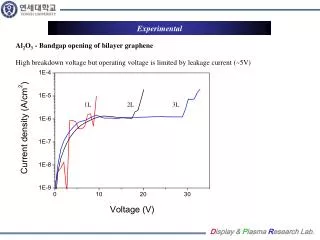
This study explores the bandgap opening in bilayer graphene utilizing Al2O3 and HfO2. We assess the impact of preheating temperature and PEG quantity on the breakdown voltage and leakage current. Results indicate that reducing PEG to 20 mg/ml significantly decreases leakage while maintaining high breakdown voltages. Further, HfO2 remains amorphous up to 400 °C, critical for device reliability. Future work involves setting up reflux devices for advanced characterization with various materials, including BaTiO3-PVDF nanocomposites.

Investigating Bandgap Opening in Bilayer Graphene with Al2O3 and HfO2 for Enhanced Performance
E N D
Presentation Transcript
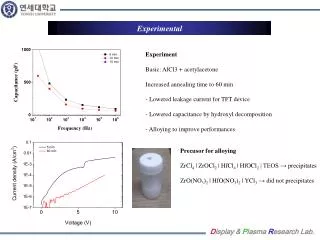
Experimental Al2O3 - Bandgapopening of bilayer graphene High breakdown voltage but operating voltage is limited by leakage current (~5V) 1L 2L 3L
Experimental Al2O3 - Bandgapopening of bilayer graphene Preheating temperature 200 ˚C → 160 ˚C: Improving coating quality, increases breakdown voltage at thinner films
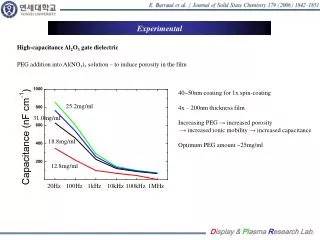
Experimental Al2O3 - Bandgapopening of bilayer graphene Reduce PEG quantity 40 mg/ml → 20 mg/ml Finally reduces leakage current density (Further reducing to 10 mg/ml reduces film capacitance from 1.2 nF to 400pF)
Experimental HfO2 – additional data XRD – HfO2 maintains amorphous phase up to 400 ˚C It is known that HfO2 crystallizes at 450 ~ 500 ˚C
Experimental BaTiO3-PVDF nanocomposite Surface treatment by phosphonic acid (x) → by H2O2 BaTiO3 NP + H2O2 Reflux at 106 ˚C, 12 hrs Centrifuge, Baking at 80 ˚C, 6 hrs Dispersion in DMF PVDF addition High loading nanocomposite (~30%) with simple method Some glass components are require for reflux
Experimental Future works Reflux device setup HfO2 – XPS ZTO – currently have I-V, XPS, TG-DTA MS-related experiment (Alkyl halide inspection) 4. ITO – NMR using 2-ME isotope