Exploring Stellar Formation: Outflows, Clouds, and the Cycle of Star Birth and Death
280 likes | 396 Vues
This presentation by Alyssa A. Goodman from Harvard University's Department of Astronomy delves into the intricate processes of star formation, including the phenomena of outflows from dying stars, molecular clouds, and their impact on stellar nurseries. It discusses the cycle of star birth and death, emphasizing how supernovae and jets influence molecular clouds and star clustering. Additional topics include the role of magnetohydrodynamic waves, thermal motions, and insights from radio spectral-line observations, offering a comprehensive understanding of our galaxy's dynamic interstellar medium.


Exploring Stellar Formation: Outflows, Clouds, and the Cycle of Star Birth and Death
E N D
Presentation Transcript
Watching New Stars Form Alyssa A. Goodman Harvard University Department of Astronomy cfa-www.harvard.edu/~agoodman
"Cores" and Outflows 1 pc = 3 lyr Molecular or Dark Clouds Jets and Disks Solar System Formation What we (think we) understand
Outflow from Dying Star Young Star Cluster Stellar Nurseries Nebulosity/Glowing Gas The Cycle of Star Birth & Death
Outflow from Dying Star Young Star Cluster Stellar Nurseries Nebulosity/Glowing Gas The Cycle of Star Birth & Death
100 mm Dust Emission in Cassiopeia Tóth et al. 1995 Some Molecular Clouds "Created" by Supernovae
"Cores" and Outflows 1 pc = 3 lyr Molecular or Dark Clouds Jets and Disks Solar System Formation What we (think we) understand
Magnetohydrodynamic Waves Infall Outflows MHD Turbulence Thermal Motions What we also understand, but don’t always admit SNe/GRB H II Regions
Time Showed Barnard was Right! Barnard’s Optical Photograph of Ophiuchus IRAS Satellite Observation, 1983 Remember: Cold (10K) dust glows, like a blackbody, in the far-infrared.
Dust, not Holes The Oschin telescope, 48-inch aperture wide-field Schmidt camera at Palomar Red Plate, Digitized Palomar Observatory Sky Survey
Tutorial:Velocity from Spectroscopy Observed Spectrum Telescope Spectrometer 1.5 1.0 Intensity 0.5 0.0 -0.5 All thanks toDoppler 100 150 200 250 300 350 400 "Velocity"
Tutorial:Velocity from Spectroscopy Observed Spectrum Telescope Spectrometer 1.5 1.0 Intensity 0.5 0.0 -0.5 All thanks toDoppler 100 150 200 250 300 350 400 "Velocity"
My Main Line of Work: Radio Spectral-line Observations of Interstellar Clouds
Radio Spectral-line Observations of Interstellar Clouds Radio Spectral-Line Survey Alves, Lada & Lada 1999
Velocity as a "Fourth" Dimension Loss of 1 dimension No loss of information
“Integrated Intensity Map” Region of Radio Spectral-Line Survey Alves, Lada & Lada 1999
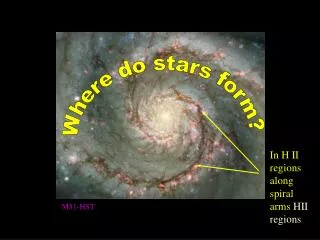
1957 H I Spectroscopy Telescope Spectrometer H I Spectrum of the Galaxy M51 from Agassiz Station,Heeschen 1957 All thanks toDoppler
1950 1960 1970 1980 1990 2000 8 10 4 10 7 10 N 6 channels, 10 channels 3 10 *N N 5 10 channels pixels S/N in 1 hour, 2 10 4 10 (S/N)*N N 3 10 1 N 10 pixels pixels 2 10 0 10 1950 1960 1970 1980 1990 2000 Year Learning More from “Too Much” Data Product S/N
Magnetohydrodynamic Waves Infall Outflows MHD Turbulence Thermal Motions The Dynamic Star-FormingInterstellar Medium SNe/GRB H II Regions
“Giant” Herbig-Haro Flows:PV Ceph 1 pc Reipurth, Bally & Devine 1997
A New Proposal: Episodic ejections from precessing or wobbling moving source Required motion of 0.25 pc (e.g. 2 km s-1 for 125,000 yr)
67:55 H H 3 1 5 C H H 3 1 5 B 67:50 H H 3 1 5 A H H 4 1 5 HH 215P2 ) 0 HH 215P1 5 9 1 ( PV Cephei d 67:45 HH 315D H H 3 1 5 E 67:40 H H 3 1 5 F 20:46 20:45 ( 1 9 5 0 ) a PV Ceph 12CO (2-1) OTF Map from NRAO 12-m Red: 3.0 to 6.9 km s-1 Blue: -3.5 to 0.4 km s-1 Arce & Goodman 2001
More Questions? • cfa-www.harvard.edu/~agoodman