The Dollar Tree
140 likes | 255 Vues
Dollar Tree Stores, Inc. is a value-driven variety store operating at a one-dollar price point. Founded in 1953 and headquartered in Chesapeake, VA, it emphasizes customer orientation and profitability, empowering associates and promoting honest dealings. With over 2,900 stores and significant revenue growth, Dollar Tree targets low-medium income households and focuses on a wide range of affordable merchandise. Despite facing competitive pressures and challenges in customer service and product presentation, it aims for market share growth in discount merchandise, capitalizing on strategic store placements.


The Dollar Tree
E N D
Presentation Transcript
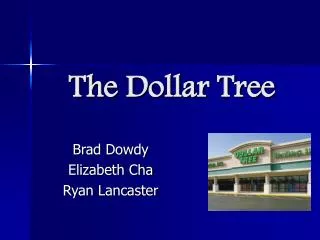
The Dollar Tree Brad Dowdy Elizabeth Cha Ryan Lancaster
Mission Statement • Dollar Tree Stores, Inc. is a customer-oriented, value driven variety store, operating at a one dollar price point. It will operate profitably, empower its associates to share in its opportunities, rewards and successes; and deal with others in an honest and considerate way. The company's mission will be consistent with controlled and profitable growth.
Background Info. • Established in 1953 and headquarters in Chesapeake, VA. • Acquired numerous companies • 4 similar companies from 1996-2000 • As of Dec. 31, 2005: • #75 on top 100 businesses • Revenue: $3.3 billion (+8.6% from 2004) • # of stores: 2,914 • Stock price: $31.20 (DLTR/NYSE)
Who & Why? • Low-Medium income households • Dollar Tree locations typically anchored next to mass merchandisers (ex: Walmart & Target) • Convenience • Variety of Merchandise • $1 price ceiling
Product Category • Division 1 • Party Goods, Stationery, Gifts, Crafts/Notions • Division 2 • Fashion Accessories, Softlines, Floral, Valentine/Easter, Halloween, Thanksgiving/Fall Seasonal, Christmas, Baby, Books, Toys • Division 3 • Candy, Food, Health/Beauty Care • Division 4 • Household Consumables, Housewares, Pet Supplies, Electronics, and Hardware
Types of stores • The Dollar Tree chooses three different store locations. • Large strip center or mall • Small strip center • Stand alone store
What Do We Look For? • Regional centers, anchored by "big box" discounters or dominant grocery stores. • Freestanding locations in a strong retail corridor, with street presence and easy in/out and plenty of parking. • Shopping centers that are highly visible and have strong traffic counts. • Back door freight delivery, accessible by tractor-trailers
Anchored by large discount or grocery store (25-33%) Inside a mall (18%) Freestanding or strip centers (about 50%) Dollar Tree employs Grid Layout in the Corvallis location Store Layout
Strengths • Pricing of merchandise at $1.00 • Wide range of merchandise • Potential industry growth and square footage growth. • Corvallis • Located within a small strip center (other retailers to draw customers in) • Little direct competition
Weaknesses • Customer Service • Quality and quantity • Poor product presentation • Lack of cleanliness • Corvallis • Above! • Location in relation to campus • Strip mall retail selection (run down strip aesthetics) • Poor signage
Opportunities for the Dollar Tree • Relatively slow growth in U.S market, but stores that focus on discount merchandise will generally gain market share from independent more higher priced retailers. • Larger stores are seeking tighter inventory control. • Take advantage of manufacturers excess production capacity. • Corvallis • Students love anything cheap • Not much direct competition • Large and small strip centers available for retail space. • Sponsorships
Threats • Fixed price model limits power and gross margin enhancement. • Margins pressured by merchandise cost, labor and shipping expenses and energy increases. • Competition for super centers and other discount stores, including other “dollar stores” (ie Dollar Discount and Fred’s). • Corvallis • Kmart, Bi-Mart, Rite-Aid, Ross (volume and quality)
Sources • http://www.stores.org/pdf/06%20JULY%201-100%20Chart.pdf • http://www.dollartree.com/ • http://mason.wm.edu/NR/rdonlyres/B269B202-3EBF-4F05-8AFA-88AFA9520E9C/0/Dollar_Tree_REPORT.pdf