Female Reproductive System
470 likes | 587 Vues
This guide provides essential medical terminology related to the female reproductive system, including definitions and functions of key components such as the ovaries, fallopian tubes, uterus, and vagina. The text highlights the menstrual cycle phases, pregnancy changes, labor stages, and reproductive disorders impacting women's health. Additionally, it outlines terms related to childbirth, lactation, menopause, and common menstrual disorders, enhancing comprehension of female anatomy and physiology.


Female Reproductive System
E N D
Presentation Transcript
Female Reproductive System Medical Terminology
Key Terms • Fulguration = tissue destruction using electrical current • Genitalia • Gestation = time from conception to birth • Glans = erectile tissue on clitoris & penis • Lactation = milk production & release
Key Terms • Puerperium = first 6 post-partum weeks during which maternal anatomy & physiology returns to nonpregnant state • viable
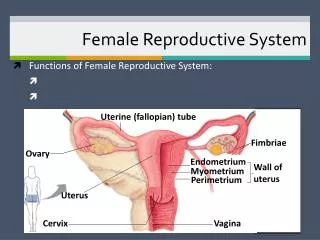
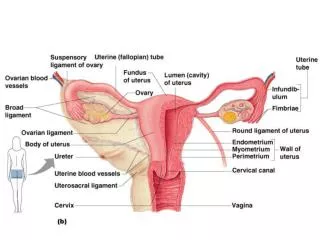
Anatomy • Ovaries • Fallopian tubes • Uterus • Vagina • External genitalia • Labia minora, labia majora, clitoris, Bartholin glands
Anatomy • Ovaries • Contain many graafian follicles • Become mature follicles that rupture out of ovaries, releasing ovum (ovulation) • Becomes corpus luteum (makes estrogen and progesterone) • Fallopian tubes • Have fimbriae at open ends • Attach to superior parts of uterus
Anatomy • Uterus • Between bladder and rectum • Anteflexed (bent forward) • Fundus, body, cervix • Vagina • From cervix to exterior • Bartholin glands make lubricating secretions during sex • Clitoris: erectile tissue anterior to vagina
Anatomy • Perineum • Between vaginal orifice & anus • May require episiotomy during childbirth • Mammary glands • Functional only in females • Lactation (secretion of milk) • Adipose tissue, lactiferous ducts (open onto nipple), areola
Menstrual Cycle • From menarche to menopause • Approximately 28 days in length • Three Phases • Menstrual (days 1-5) • Ovulatory (days 6-14) • Postovulatory (days 15-28)
Menstrual Cycle • Menstrual Phase • Endometrium sloughs off, bleeding • Ovulatory Phase • New endometrium grows & thickens • Graafian follicles mature, only one ovum fully matures • Approximately day 14, ovulation occurs
Menstrual Cycle • Postovulatory Phase • Corpus luteum forms, secreting estrogen and progesterone • These hormones stimulate endometrium and prepare it for implantation • Then corpus luteum degenerates and hormone levels fall, leading to deterioration of endometrial layer until menses begin
Pregnancy • Gestation of approximately 9 months • Parturition = childbirth • Changes during pregnancy: • Uterus becomes larger, more muscular • Placenta grows in uterus • Vaginal canal elongates, mucosa thickens and secretions increase, becomes more elastic • Breast enlargement
Labor and Childbirth • Three phases of labor • Dilation • Onset of contractions till complete dilation of cervix (cx) • Expulsion • From complete dilation until infant is delivered • Placental expulsion • From delivery of infant till delivery of placenta (after birth)
Menopause • End of ovarian activity & decreased hormone production • Average age in US is 51. • Clinical S/S: amenorrhea, vaginal atrophy, low estrogen levels • Also called “change of life” • HRT = hormone replacement therapy • Treats menopause symptoms, osteoporosis, vaginal atrophy • Not cardioprotective, risk for certain cancers
Combining Forms • Amnio- (amniotic sac) • Cervico- • Colpo- or vagino- • Galacto- or lacto- (milk) • Gyneco- (female) • Hystero- (uterus) • Mammo- or masto- (mammary gland)
Combining Forms • Meno- (menses, menstruation) • Metrio-, utero-, or metro- (uterus) • Nato- (birth) • Oophoro- or ovario- • Perineo- (perineum) • Salpingo- (fallopian tubes)
Suffixes • -arche (beginning) • -cyesis (pregnancy) • -gravida (pregnant female) • -para (to bear offspring) • -salpinx (fallopian tube) • -tocia (childbirth, labor) • -version (turning)
Prefixes • Ante- (before) • Dys- • Endo- • Multi- • Post- • Primi- (first)
Specialists • Gynecology • Health and diseases of female reproductive tract • Obstetrics • Care of the woman and fetus during pregnancy, childbirth, and puerperium
Menstrual Disorders • Etiologies: • Hormonal dysfunction • Uterine pathology • Dysmenorrhea: menstrual pain • Due to chronic disorders, tumors • Treatment in some cases: estrogen • Metrorrhagia: irregular uterine bleeding between menses • Often related to benign or malignant tumors • May also be hormonal uterine dysfunction
Menstrual Disorders • Menorrhagia/hypermenorrhea: profuse or prolonged menstrual bleeding • Premenstrual syndrome (PMS): • S/S start several days prior to menses and end when menses start or shortly after • S/S vary: HA, fatigue, mood changes, anxiety, depression, fluid retention
Endometroisis • Pathological presence of endometrial tissue outside of the uterus • Usually in pelvic area • May be anywhere in abdominal cavity • Functional tissue, responds to hormonal cycle • Implants, lesions, growths • S/S: pain, infertility often
Infections • Pelvic Inflammatory Disease (PID) • Inflammation of uterus, fallopian tubes, ovaries due to bacterial infection • Ascending infection from vagina & cervix (Cx) • Most common STD’s: chlamydia, GC • Complications: scarring of tubes & ovaries, causing infertility, ectopic pregnancies
Infections • Vaginitis • Acid vaginal secretions protective to a degree • Localized infections • Bacterial, viral, fungal • Common types: trichomoniasis and candidiasis (moniliasis, associated with antibiotic use) • S/S: itching, vaginal discharge, urethritis
Other STD’s • Venereal diseases, most common reproductive disorder, over 20 types • AIDS is considered STD • Most common type: chlamydia over last few decades • Prior to that: syphilis & gonorrhea were the most common
Sexually Transmitted Diseases • Gonorrhea • Bacterial, Neisseria gonorrhoeae • MM’s of reproductive & GU tracts, pharynx, and rectum, may cause PID • Purulent, yellowish-green discharge • Silver nitrate prophylaxis for neonatal conjuctivitis • May cause arthritis, cystitis, pharyngitis also
Sexually Transmitted Diseases • Syphilis • Bacterial, Treponema pallidum • Less common than GC, more serious • Chronic multisystem acquired or congenital infection • more commonly STD and in immunocompromised patients • Painless chancre at entrance site • Transmission frequently occurs early in the disease • Late stages: neurological symptoms, death
Sexually Transmitted Diseases • Genital Herpes • Viral infection, often HSV-2 • Vesicular lesions, like cold sores • Transmission via vesicular fluid and viral shedding from skin of patient • First outbreak has systemic signs often • Fever, myalgias, etc. in addition to genital vesicles
Sexually Transmitted Diseases • Chlamydia • Bacterial, Chlamydia trachomatis • Most common STD, may be asymptomatic until irreversible damage to GU tract occurs • STD mostly, also congenital • Discharge whitish, milder symptoms than GC • Neonates: congenital conjunctivitis, pneumonias
Sexually Transmitted Diseases • Genital Warts • Condylomas • Viral, Human papilloma virus (HPV) • Vary from single and tiny to large clusters • May resolve spontaneously, require excision or liguid nitrogen topically • Increased risk of miscarriages • Increased risk of cancers • Penile, vaginal anal and cervical CA (80% of invasive cervical cancers)
Sexually Transmitted Diseases • Trichomoniasis • Protozoan, Trichomonas vaginalis • Females more commonly symptomatic • Frothy yellow-green discharge
Uterine Fibroids • Benign uterine tumors • In approx 30-40% of females • Etiology: fluctuating endocrine stimulation in 20’s to 40’s • May have no symptoms or cause menorrhagia, back pain, constipation, urinary symptoms • May interfere with pregnancy • Treatment varies with size & location of fibroid
Ovarian Cysts • Common in virtually all females • Form and resolve spontaneously often • Frequent corpus luteum cysts • If persistent, may cause ovarian tortion (emergency, may cause ischemia & necrosis) • May be chronic or acute • May be benign or malignant (infrequent)
Ectopic Pregnancy • Implantation of fertilized ova outside of the uterus • Fallopian tubes most common site, may be on ovaries, abdominal cavity wall • Non-viable pregnancy • If large enough, rupture could cause hemorrhagic shock and death • Treatment: surgical resection
Obstetrical Disorders • Spontaneous abortion • Miscarriage, most common in 1st trimester • Usual cause is genetic/chromosomal abn. • Threatened abortion • Vaginal bleeding, with or without cramping • Premature Rupture of Membranes (ROM) • Amniotic sac leaks, ruptures • Increased chance of maternal-fetal infection and premature labor
Obstetrical Disorders • Pre-eclampsia • Third trimester condition involving hypertension & proteinuria • Increased risk of complication to mother and fetus • Eclampsia (toxemia) • Seizure occurs, often intracranial bleeding • Delivery is the main treatment • High risk of maternal death
Childbirth Disorders or Complications Placental problems partial retention/ bleeding or sepsis • Vaginal bleeding • Abruptio placenta or placenta previa • Prematurity • Pulmonary/surfactant deficiency • Small for gestational age
Oncology • Breast Cancer • Most common CA in US females • Associations: ovarian hormonal dysfunction, high fat diet, family hx, HRT • Higher risk in nulliparous, early menarche, late menopause patients
Oncology • Cervical Cancer • Ages 40-49 characteristically • Associations: early first coitus, more numerous sexual partners, STD’s, partners of other cervical CA pts. • Pap smear (Papanicolaou test), colposcopy
Related Terms • Adnexa • Atresia = congential absence of a normal orifice • Choriocarcinoma • Corpus leuteum • Contraceptive diaphragm • dyspareunia
Related Terms • Oligomenorrhea • Puberty • Pyosalpinx • Retroversion • Vaginismus • Abruptio placentae • Abortion
Related Terms • Amnion • Breech presentation • Down syndrome/ Trisomy 21 • Dystocia • Gravida = pregnant woman • Multigravida • Multipara = woman who has delivered more than one viable infant
Related Terms • Para = woman who has given birth to one or more viable infants • Parturition • Pelvimetry • Placenta previa • Primagravida = women in her 1st pregnancy
Related Terms • Primipara = woman who has given birth to her first viable child • Puerperium = 42 day period after childbirth
Diagnostic Terms • Amniocentesis • Colposcopy • Lararoscopy • Endometrial biopsy • Pap test/smear • Mammography • Ultrasonography (pelvic, transvaginal)
Related Terms • Hysterosalpingography • Cerclage= ligature of incompetent Cx • Cesarean birth • Conization • Dilatation & curettage (D & C) • Episiotomy & episiorrhaphy • Hysterectomy (subtotal, complete)
Related Terms • Total Abdominal Hysterectomy with Bilateral salpingo-oophorectomy (TAH with BSO) • Intrauterine device (IUD) • Lumpectomy • Mastectomy, radical or simple • Tubal ligation
Pharmacology • Antifungals • Estrogens • Oral contraceptives • Oxytocics • Prostaglandins (used to terminate pregnancy)