Mastering Note-Taking with Cornell Notes: Boost Learning and Critical Thinking Skills
Explore the benefits of the Cornell note-taking system to enhance your learning experience. This method promotes critical thinking by helping you to organize and process information effectively. Take notes during class to retain crucial details, collaborate with peers on assignments, and prepare for tests. Good notes serve as a valuable resource, allowing you to summarize key concepts in your own words. With the Cornell method, ensure you include vocabulary, questions, and summaries, making studying more efficient.


Mastering Note-Taking with Cornell Notes: Boost Learning and Critical Thinking Skills
E N D
Presentation Transcript
Cornell Notes SEMS Spin
Why take notes? • Cornell note taking stimulates critical thinking skills. • Note taking helps you • remember what is said in class. • A good set of notes can help you work on assignments and prepare for tests outside of the classroom.
Why take notes? • Good notes allow you to work together with other students to problem solve. • Good Notes help you organize and process information. • Writing is a great tool for learning!
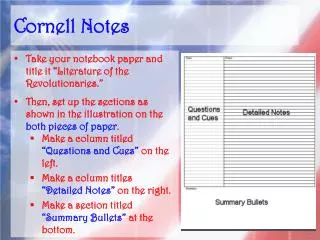
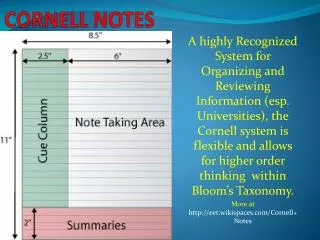
Name Period Date Topic • CA standard • Vocabulary, • questions, • problems, • etc. Class Notes 2 1/2” 3 to 4 sentence summary across the bottom of the last page of the day’s notes
SEMS Cornell Notes Spin Name Period Date Topic “QPs” Notes/details CA Standard What is? (Begin with vocabulary words for the lesson) Next Question/ Problem Definitions …… Notes / details Summary Describe key details in your own words
Name Period Date Math Cornell Notes Topic: 1.2 Variable Expressions Notes/details QPs
QPs Notes Science/ Biology Notes CA 9.3 Summary
Science Cornell Notes Name Period Date Topic: Energy and Matter Chapter 2.3 Big idea Questions should be written down with space to fill in the answers: Q: How is chemical energy related to chemical change? A: ….. QPs
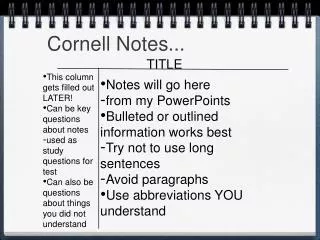
Review: What goes where? Don’t forget the Heading: Name, Period, Date, and Topic • CA Standard • Questions, • (start with • vocabulary • words) • Problems, • etc. go here, • in the left • hand column. • Remember, • you want • higher level • thinking • questions. Notes go here, in the large right hand column. A 3 to 4 sentence summary down there on the bottom of the last page of notes
Practice Time • Pull out your notes for Chapter 2.3 and see how you did.
Instructions • In the large, right hand column, take notes like you normally would. • You may use any style of note-taking you wish: • outline format, • narrative format, • symbols, • short hand, etc.
Adapted for SEMS from a design by Paul Bullock Senior Program Specialist & Anne Maben AP Science Coach Minor modifications for Science made by Mrs. Bernard