Understanding Noise, Uncertainty, and Probability Distributions in Astronomy
This lecture delves into the concepts of accuracy and precision, emphasizing their importance in astronomical measurements. We explore various probability distributions, including Gaussian, Binomial, and Poisson, explaining how they model different types of data. The Gaussian distribution, known for its descriptive power over statistical data, is examined in detail, alongside the Central Limit Theorem, which relates to the aggregation of independent random variables. Practical examples illustrate the application of these concepts, particularly in measuring uncertainty and signal-to-noise ratios in astronomical contexts.

Understanding Noise, Uncertainty, and Probability Distributions in Astronomy
E N D
Presentation Transcript
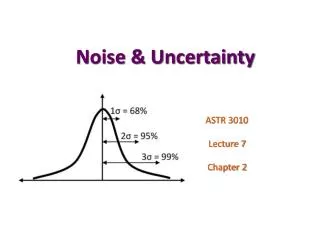
Noise & Uncertainty ASTR 3010 Lecture 7 Chapter 2
Accuracy & Precision True value systematic error
Probability Distribution : P(x) • Uniform, Binomial, Maxwell,Lorenztian, etc… • Gaussian Distribution = continuous probability distribution which describes most statistical data well N(,)
Binomial Distribution • Two outcomes : ‘success’ or ‘failure’ probability of x successes in n trials with the probability of a success at each trial being ρ Normalized… mean when
Gaussian Distribution Uncertainty of measurement expressed in terms of σ
Central Limit Theorem • Sufficiently large number of independent random variables can be approximated by a Gaussian Distribution.
Poisson Distribution • Describes a population in counting experiments number of events counted in a unit time. • Independent variable = non-negative integer number • Discrete function with a single parameter μ • probability of seeing x events when the average event rate is • E.g., average number of raindrops per second for a storm = 3.25 drops/sec at time of t, the probability of measuring x raindrops = P(x, 3.25)
Poisson distribution Mean and Variance use
Signal to Noise Ratio • S/N = SNR = Measurement / Uncertainty • In astronomy (e.g., photon counting experiments), uncertainty = sqrt(measurement) Poisson statistics Examples: • From a 10 minutes exposure, your object was detected at a signal strength of 100 counts. Assuming there is no other noise source, what is the S/N? S = 100 N = sqrt(S) = 10 S/N = 10 (or 10% precision measurement) • For the same object, how long do you need to integrate photons to achieve 1% precision measurement? For a 1% measurement, S/sqrt(S)=100 S=10,000. Since it took 10 minutes to accumulate 100 counts, it will take 1000 minutes to achieve S=10,000 counts.
Weighted Mean • Suppose there are three different measurements for the distance to the center of our Galaxy; 8.0±0.3, 7.8±0.7, and 8.25±0.20 kpc. What is the best combined estimate of the distance and its uncertainty? wi = (11.1, 2.0, 25.0) xc = … = 8.15 kpc c= 0.16 kpc So the best estimate is 8.15±0.16 kpc.
Propagation of Uncertainty • You took two flux measurements of the same object. F1 ±1, F2 ±2 Your average measurement is Favg=(F1+F2)/2 or the weighted mean. Then, what’s the uncertainty of the flux? we already know how to do this… • You need to express above flux measurements in magnitude (m = 2.5log(F)). Then, what’s mavg and its uncertainty? F?m • For a function of n variables, F=F(x1,x2,x3, …, xn),
Examples • S=1/2bh, b=5.0±0.1 cm and h=10.0±0.3 cm. What is the uncertainty of S? S h b
Examples • mB=10.0±0.2 and mV=9.0±0.1 What is the uncertainty of mB-mV?
Examples • M = m - 5logd + 5, and d = 1/π = 1000/πHIP mV=9.0±0.1 mag and πHIP=5.0±1.0 mas. What is MV and its uncertainty?
In summary… Important Concepts Important Terms Gaussian distribution Poisson distribution • Accuracy vs. precision • Probability distributions and confidence levels • Central Limit Theorem • Propagation of Errors • Weighted means • Chapter/sections covered in this lecture : 2