Download
1 / 10
100 likes | 215 Vues
This document details the outcomes of the CTF3 committee's findings from 2010, focusing on the acceleration and power production advancements achieved through enhanced beam transmission techniques in TBTS/PETS. Key improvements include a record current and optimized combination for DL and CR rings, leading to accelerated probe beams of up to 18 MeV. The report highlights RF phase stability, emittance measurements during various combinations, and calibrations that ensure reliable power production. Notable studies on bunch phase and transmission optimization have been identified as crucial to maximizing performance.

E N D
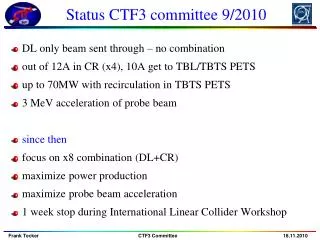
Status CTF3 committee 9/2010 • DL only beam sent through – no combination • out of 12A in CR (x4), 10A get to TBL/TBTS PETS • up to 70MW with recirculation in TBTS PETS • 3 MeV acceleration of probe beam • since then • focus on x8 combination (DL+CR) • maximize power production • maximize probe beam acceleration • 1 week stop during International Linear Collider Workshop
Factor 8 combination (DL+CR) • Combination well optimized in operation • transmission • closure • path length • => record currentthis year(MKS13 off)
12 GHz bunch phase studies • For 12 GHz power production, bunch phase along the pulse crucial • => need stable beam energy, klystron phases, beam current • DL, CR ring length, orbit, closure carefully optimized • used RF pulse compression to minimize ∆E/E after the linac => • D0608=0.61m => 13mm = ~2% to ~3mm = ~0.5% ∆E/E • detailed studies of bunch phase, variation understood and minimized => 12 GHz RF phase 20 deg => 100 deg Erik Adli, ReidarLillestøl
Emittance • measured in H and V for various stages of combination • emittance increase more from CR than from DL SimonaBettoni
TL2 - TBTS • good transmission also for x8 combined beam from CR • >17A get to TBTS PETS x8 recombination in CR
TBTS - PETS • up to>250MWin PETS structure (?) • >100MW to structure (?) • RF calibration verified/corrected • signals internally consistent • deceleration studies suggest overestimation of power measurement
Probe beam acceleration • probe beam acceleration optimized • in time • in phase • up to 18 MeV=> gradient ~90 MV/m Andrea Palaia
Probe beam acceleration • acceleration less than expected • power calibration, structure frequency, other modes? connection to 30˚C water SimonaBettoni
Probe beam acceleration • probe beam changes shape when accelerated(measured on straight screen for different focusing) without with acceleration
Schedule– restart 31/1/2011 Optics improvements (DL dispersion) Full transport to CLEX Bunch length control (first tests) TBTS initial PETS tests CALIFES setup new setup when MKS13 available? 1 PETS conditioned to nominal power/pulse lengthTBL PETS tests 2 • Two-Beam test • power & energy gain, 100MV/m Accelerating structure conditioned to nominal power/pulse length 3 Beam PETS breakdown rate measurements??? • TBL studies(limited) 4 1 3 2 • Beam Loading compensation experiment • Measurement of breakdown kicks 5 3 2 1 • Measurement of effect of beam loading on breakdown rate 6 4 5 6 Test of new PETS on-off scheme 7 • TBL studies 30% deceleration ? • Stability studies & improvements • PETS no recirculation • Phase stability • Operation at 5 Hz (or more) • Control of beam losses • Coherent Diffraction Radiation … 8 • installTBLPETS?? • <----> 6 4 5 • 2nd TBL PETS installation • 6 weeks PHIN • phase-coding • Laser preparation 7 8 7 8