Download
1 / 12
120 likes | 233 Vues
This paper discusses the conceptual status and future prospects of finite automata models in quantized systems. It covers topics such as information being physical, continuum theory, deterministic chaos, quantum computing speedups, Turing barrier, quantum complementarity, Mealy automaton logic, automaton partition logic, reversible automata, value definiteness in quantum mechanics, counterfactual automata, and the base n-information in quantum mechanics. The applicability of automata in comparison to quantum mechanics is explored through examples. The study also delves into intrinsic physical properties of virtual realities and computer games, emphasizing the unique look and feel of computer-animated worlds.

E N D
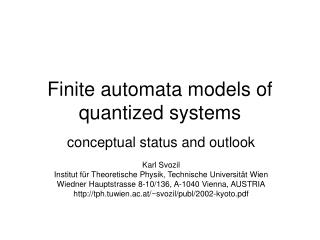
Finite automata models of quantized systems conceptual status and outlook Karl Svozil Institut für Theoretische Physik, Technische Universität Wien Wiedner Hauptstrasse 8-10/136, A-1040 Vienna, AUSTRIA http://tph.tuwien.ac.at/~svozil/publ/2002-kyoto.pdf
Information is physical • Continuum theory and „deterministic chaos“ • Possible speedups in quantum computing • Suggestions to trespass the Turing barrier
Edward F. Moore (1956 ): formalization of complementarity • Quantum complementarity is the feature of certain microphysical systems not to allow the determination of all of its properties with arbitrary precision at once. • Example: Mealy automaton
Recent developments • Characterizazion of types of Complementarity • Simulation, universality and complementarity • Automaton partition logic (C. S. Calude, E. Calude, B. Khoussainov,M.Schaller, M. Lipponen, K.S.)
Reversible automata • Combined transition and output functions are bijective, evolution is a permutation
Value definiteness in qm? Nonexistence of two-valued measures (truth values) in quantized systems of Hilbert space dimension >2
Base n-information in qm • a n-state particle carries exactly one nit of information • k n-state particles carry exactly k nits of information • Realizable by automata {{{1, 2, 3}, {1, 4, 5}, {2, 6, 7}, {3, 8, 9}, {4, 6, 8}, {5, 7, 9}},{{1, 2, 3}, {1, 4, 5}, {2, 6, 7}, {3, 8, 9}, {4, 6, 9}, {5, 7, 8}},{{1,2,3},{{1,4,7},{2,5,8},{3,6,9},{4,5,6},{7,8,9}}, {{1, 6, 9}, {1, 7, 8}, {2, 4, 9}, {2, 5, 7}, {3, 4, 8}, {3, 5, 6}}, {{1, 6, 9}, {1, 7, 8}, {2, 4, 9}, {2, 5, 8}, {3, 4, 7}, {3, 5, 6}}}. (Zeilinger 1999, K.S. 2002)
Applicability • Automata sometimes behave differently than qm; e.g., {{{1},{2},{3,4}},{{1},{2,4},{3}},{{1,4},{2},{3}}}. • ``intrinsic physical properties'' of virtual realities in general, and computer games in particular; the intrinsic ``look and feel'' of computer animated worlds.