Download
1 / 28
280 likes | 401 Vues
This comprehensive guide covers key concepts in physics related to momentum, work, and power. The material includes warm-up problems, example calculations, and real-world applications. Students will learn how to calculate the mass of objects, work done, and the power used in various scenarios, reinforcing their understanding of conservation of momentum. Assignments include reading chapters and solving specific problems to deepen comprehension. Ideal for students needing to improve their skills in physics or prepare for assessments.

E N D
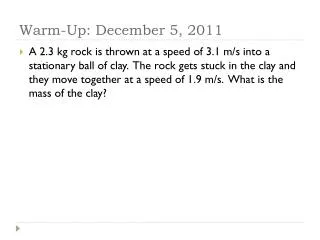
Warm-Up: December 5, 2011 • A 2.3 kg rock is thrown at a speed of 3.1 m/s into a stationary ball of clay. The rock gets stuck in the clay and they move together at a speed of 1.9 m/s. What is the mass of the clay?
Momentum Assignments • Conservation of Momentum WS due tomorrow • Homework due Wednesday: • Read Chapter 9 • Page 235 #7-9 • Page 250 #32-34, 38, 40, 57, 73, 80
Work and Power Section 10.1
Work • Work is done when a force acting on an object causes it to move in the same direction of the force. • Work is equal to the product of force and distance • Work is represented by a capital “W” • Work has units Joules (J)
Example 1 • A rope is pulling a box across the floor. If the tension of the rope is 125 N and the box moves 4.00 m, how much work was done?
You-Try #1 • A man pushes his car 10.0 m down his driveway, pushing with a force of 250 N. How much work did the man do?
Example 2 • A weightlifter lifts a barbell 0.70 m at a constant speed by exerting 140 J. What is the weight of the barbell?
You-Try #2 • A woman pulls a refrigerator 0.50 m while exerting 250 J. With what force did she pull?
Example 3 • How far can you push a box with a force of 75 N without exceeding 100.0 J?
You-Try #3 • A mother goes for a walk while pushing a baby stroller with a force of 5.0 N. If she does 275 J of work on the stroller, how far did she walk?
Warm-Up: December 6, 2011 • A child pulls a blanket 2.2 m while exerting 11 J. With what force did the child pull?
Power • Power is the rate at which work is being done. • Power is represented by a capital “P” • “Work overtime to get more power.” • Power is measured in Watts (W)
Example 4 • A rope is pulling a box across the floor. The tension of the rope is 125 N and the box moves 4.00 m. If it takes 20.0 s to move the box, how much power is used?
You-Try #4 • A man pushes his car 10.0 m down his driveway, pushing with a force of 250 N. If the man takes 50.0 s to move his car, how much power did it take to move the car?
Example 5 • A weightlifter lifts a barbell 0.70 m at a constant speed by exerting 140 J. If it takes 210 W to move the barbell, how many seconds did it take?
You-Try #5 • A woman pulls a refrigerator 0.50 m using 300 W while exerting 250 J. How many seconds did it take to move the refrigerator?
Example 6 • How much work is produced by a power of 125 W in exactly 30 seconds?
You-Try #6 • If a runner uses 750 W for 15 s, how much work does she do?
Example 7 • A box is pushed 14.9 m at a constant speed of 1.8 m/s. The box has a mass of 21 kg and the coefficient of kinetic friction between the box and the floor is 0.45. Calculate: • Force of gravity (weight) of the box • Normal force • Friction force • Push force • Work • The time it takes to move the box • Power
Warm-Up: December 7, 2011 • A rope is pulling a box across the floor. The tension of the rope is 75.0 N and the box moves 3.00 m. If it takes 15.0 s to move the box, how much power is used?
You-Try #7 • A box is pushed 7.9 m at a constant speed of 3.3 m/s. The box has a mass of 12 kg and the coefficient of kinetic friction between the box and the floor is 0.45. Calculate: • Force of gravity (weight) of the box • Normal force • Friction force • Push force • Work • The time it takes to move the box • Power
Assignments • Work and Power worksheet • For #6, air resistance is negligible. • Read Chapter 10 • Page 278 #52-57, 59